HBD and Hi-Light Titanium Bicycles Advance Lightweight Titanium Frame Production Through Metal Additive Manufacturing!
By Ashutosh Arora
Shanghai Hanbang 3D Tech Co., Ltd. (HBD), a leading Chinese metal Additive Manufacturing (AM) technology provider, has partnered with Hi-Light Titanium Bicycles to bring industrial-grade metal AM into the production of high-performance titanium bicycle frames. This collaboration marks a major step forward in redefining how premium bicycle frames are designed, engineered and manufactured.
Titanium has long been prized in the cycling world for its exceptional combination of low weight, high strength and corrosion resistance. However, as consumer demand grows for lighter, more aerodynamic and more advanced frame geometries, traditional manufacturing methods such as casting, machining and welding are reaching their limits. These conventional processes are often constrained by long tooling cycles, high machining costs and limited freedom to design intricate shapes or integrated features.
HBD’s metal AM technology overcomes these limitations by enabling unprecedented flexibility in frame architecture. Through topology optimisation, simulation-driven design, lattice structures and thin-wall strategies, engineers can drastically reduce frame weight while maintaining — or even improving — stiffness, durability and ride quality. Features like internal cable routing, aerodynamic shaping and unified frame joints can now be produced as a single, seamless structure, eliminating the weaknesses and inconsistencies associated with multi-part welded assemblies.
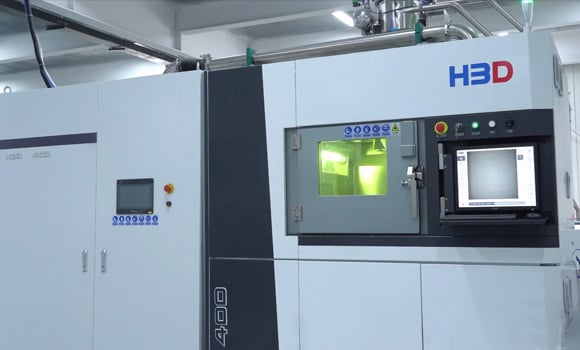
A key enabler in this transformation is the HBD 400 metal AM system, which is specifically engineered for production-grade accuracy, stability and throughput. According to HBD, the HBD 400 cuts production lead times by more than 50% compared with traditional titanium fabrication techniques. Its multi-laser architecture allows multiple components — including different frame parts or entire assemblies — to be produced simultaneously within the same build chamber. This parallel production capability has empowered Hi-Light Titanium Bicycles to respond quickly to market demand and fulfil highly customised frame orders for more than 100 international clients at once.
This shift from sequential to parallel manufacturing is reshaping Hi-Light’s development workflow. New frame designs can be validated faster, tested earlier and optimized more efficiently, accelerating the company’s innovation cycles and shortening time-to-market for next-generation lightweight models. Combined with the precision, repeatability and design flexibility of metal AM, Hi-Light is now positioned to deliver distinctive, high-performance titanium frames with features that are difficult or impossible to achieve using traditional production techniques.
The success of this collaboration demonstrates the real-world value of metal Additive Manufacturing beyond prototyping, establishing it as a reliable and scalable solution for end-use production in demanding applications. As lightweight performance continues to drive premium bicycle design, HBD’s AM technology is helping manufacturers like Hi-Light unlock new engineering possibilities and redefine boundaries in the global cycling industry.