

08:24
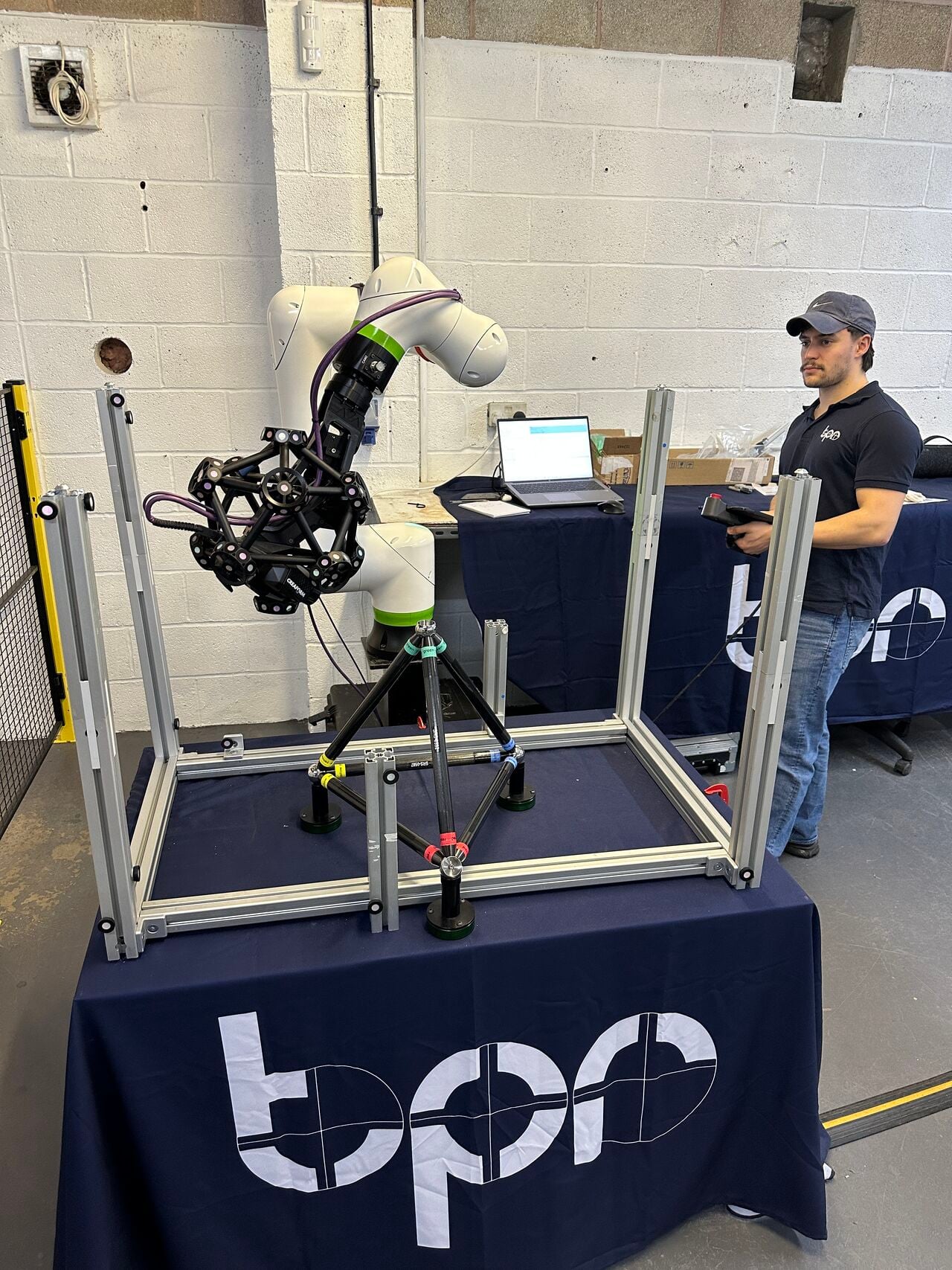
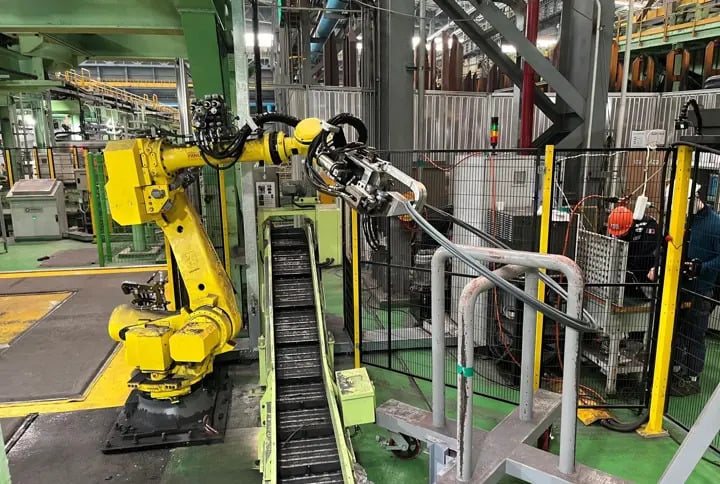
True Position Robotics (TPR) is a UK-based automation company solving the accuracy and productivity challenges that have long plagued large parts and aerostructure assembly. Founded on patented technology, TPR’s founder, Roger Holden, addressed the fundamental accuracy limitations of industrial robots more than two decades ago. TPR has taken that technology from concept to a commercially deployable platform. Now, robotic cells with vision systems can be rapidly deployed to large aerostructures to undertake precision processes, such as drilling and countersinking, profiling, applying adhesives, riveting and more – all at a fraction of the cost and set-up times.
Following successful commercial deployments at Boeing and BAE Systems, TPR is bringing its Automated Drilling and Inspection (ADI) system to the wider market as a commercially proven solution. The company’s message is straightforward: a technology once available only through bespoke, project-by-project engagement is now accessible to the broader aerospace and defence supply chain. It’s faster to implement, more commercially viable, and proven in the industry’s most demanding production environments.
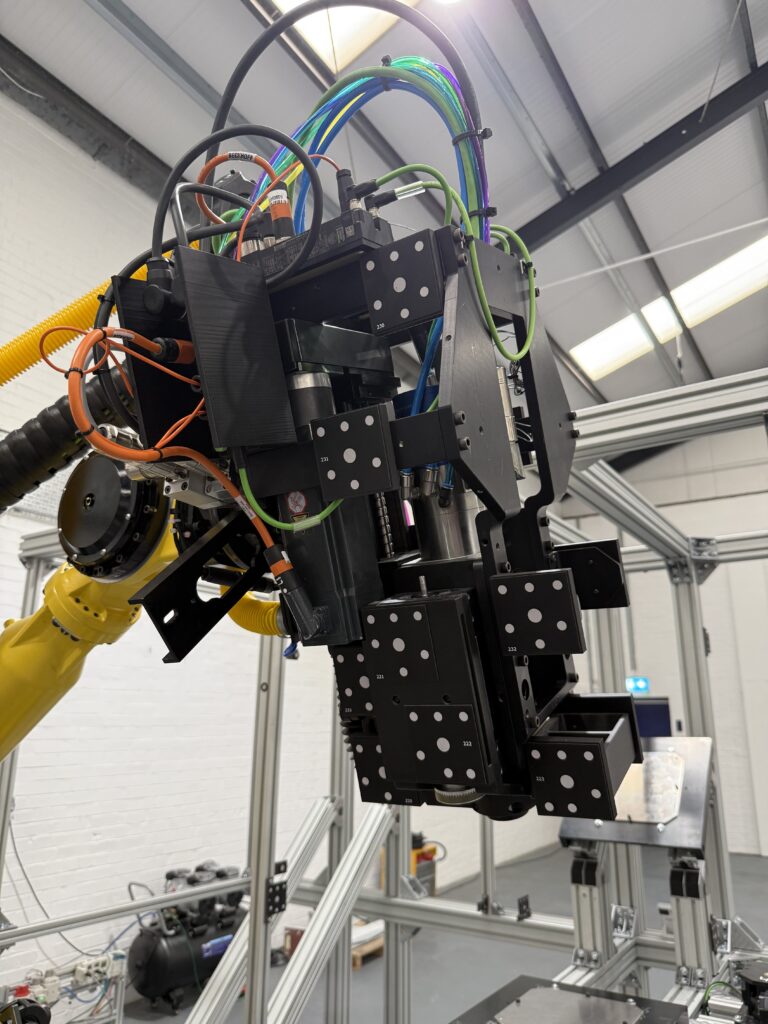
With the patented technology already operating on the factory floors of Boeing and BAE Systems, Commercial Director at True Position Robotics (TPR), Leigh Tricklebank, says: “We’ve done it for the most reputable companies; now we go to the marketplace and sell this commercially around the world.”
Why TPR Exists: The Crisis of a Rate
To understand TPR’s proposition, it is necessary to understand the scale of the problem it was created to solve. Drilling, countersinking, and inspecting aerostructure parts are among the most demanding and labour-intensive processes in advanced manufacturing. A single aircraft panel contains thousands of holes, each machined and validated to tolerances of between 100 and 300 microns. Done manually, this requires teams of skilled operators working across multiple shifts, consumes enormous time, and carries a persistent risk of rework and quality challenges, all of which add cost and delays to delivery.
The commercial pressure to change this is now acute. Airbus has set a target of 75 narrow-body aircraft per month by the end of 2026. Boeing’s supply chain backlogs run into tens of billions of pounds. Yet production rates remain well below ambition, not for lack of demand but because the manual processes underpinning aerostructure assembly have not been adequately automated. The skills pipeline is tightening further, with experienced aerostructure technicians in short supply and the broader engineering talent pool struggling to keep pace with industry growth projections extending well into the 2040s.
“One Boeing supplier alone has a backlog of £35bn that they simply cannot fill at current rates. Each part has around 2,000 holes. With five people working manually across multiple shifts, quality validation alone takes forever. Automation is not a nice-to-have — it is an existential imperative for this industry,” says Leigh Tricklebank.
The Problem Solver
TPR’s ADI system addresses four interconnected challenges. The first is accuracy. Standard industrial robots achieve positional tolerances from 1 to 15mm, far short of the 100 to 300microns required for aerostructure assembly. TPR’s patented ARC+ guidance platform incorporates large-volume real-time metrology, machine learning, and digital thread integration to deliver a consistent mean accuracy of 0.05mm with a radial tolerance of 0.2mm and a CpK of 2.91. These figures meet or exceed the most demanding aerospace design book tolerances.
The second challenge is throughput. TPR’s own data demonstrates that the ADI system performs the equivalent work of 19 skilled operators, completing each drill, countersink, and inspection cycle faster than a five-person manual team. For manufacturers trying to increase rate with existing or reduced resources, this is the core commercial proposition.
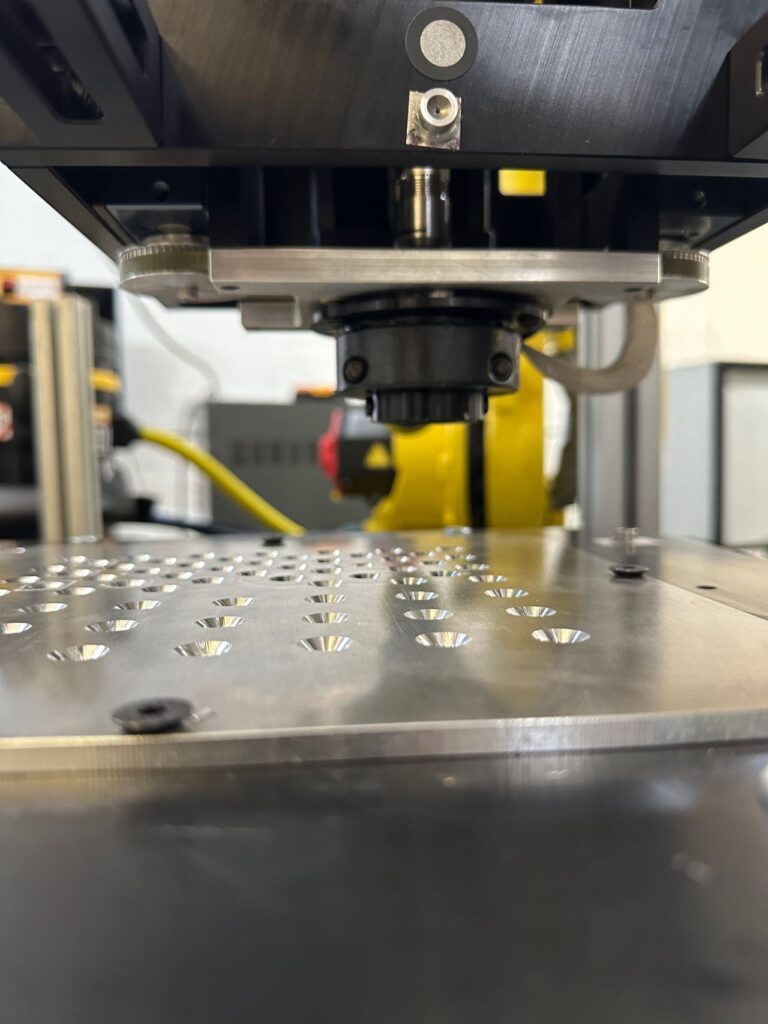
The third is traceability and quality assurance. In-process 3D geometric inspection is built directly into the ADI workflow; it’s not performed as a separate end-of-line step. A full 3D inspection of a one cubic metre assembly is completed in 60 seconds, a fraction of the time required by conventional metrology systems. All the data is fed back through the digital thread to support SPC, regulatory compliance, and zero-defect production.
The fourth challenge is cost. This relates to both the per-part production cost and, critically, the capital cost of deploying automation. This is where TPR’s offer is perhaps most compelling for the supply chain. While competing high-accuracy automated drilling solutions demand project budgets in excess of £10m, TPR’s ADI system can be delivered for less than £1m, and in many supply chain applications, it is significantly less.
“The competition comes in at £10m. We struggle to get anywhere near £2m, and on some projects we’ll be well below that. Not only is the technology better than anything else on the market, but the price point also makes automation achievable for manufacturers who previously had no viable option,” Leigh continues.
These benefits are not theoretical. Boeing, via Spirit AeroSystems at Prestwick, is operating TPR’s ADI technology in live production, achieving low-tooling robotic assembly with sub-0.1mm volumetric accuracy. BAE Systems is deploying the platform at its FalconWorks facility for the Tempest programme. GKN Aerospace, a strategic partner, has been instrumental in validating TPR’s technology against real production requirements, contributing to the company’s progression from Technology Readiness Level (TRL) 6 to TRL 8 in 2025, with TRL 9 anticipated in 2026. ITP Aero is in advanced discussions to deploy ADI for a fully automated sequence of inspect, drill, countersink, bond, and rivet — a single-cell workflow managed by one system.
Speed, Flexibility, and a Clear Path to Production
One of the most significant barriers to automation investment in the aerospace supply chain is not just cost. It is also the time and disruption required to reach production. TPR’s ADI offering overcomes this challenge with a defined implementation pathway that guides a customer from post-sale agreement to live production in a manageable, predictable sequence.
Following contract award, TPR completes its build and test phase within six months. Site acceptance tests and installation follow, with factory acceptance, training, and process validation then managed to a customer-defined schedule. The entire pathway from order to production can be achieved in less than 18 months, which is incredibly quick by the standards of bespoke aerospace automation.
Flexibility is also integral. The ADI system integrates with existing customer software environments — including Catia, Siemens NX, and Polyworks — without requiring a wholesale change to established digital infrastructure. It supports multiple end effectors within a single cell, enabling drilling, countersinking, adhesive application, and riveting to be performed in sequence with automatic tool changes. Its large-volume metrology system scales to the application, from a single camera covering three cubic metres to multi-camera configurations for assemblies exceeding 30 cubic metres. For manufacturers where part size or complexity makes fixed-cell automation impractical, TPR’s platform supports fully mobile deployment via AGV or AMR, with the robot moving around the part rather than the part being transported to the machine.
For aerospace and defence manufacturers facing the twin pressures of rising production-rate demands and a tightening skilled workforce, the case for TPR’s ADI technology has never been stronger. For the first time, a production-ready, commercially accessible route to high-accuracy automated aerostructure assembly is available to the entire supply chain.
“Stop thinking of automation as a £10m project problem. Start thinking of it as a tenth of that. An aerospace manufacturer can give us £600,000, and we’ll break the back of their automation challenge and transform their production processes and output,” concludes Leigh Tricklebank.