
08:24
The civilian aircraft backlog has reached an all-time high, equivalent to more than a decade of work at current production rates. As the industry looks to increase output without compromising quality, suppliers across the value chain are turning to automation, robotics and digital technologies to help bridge the gap. By Will Stirling
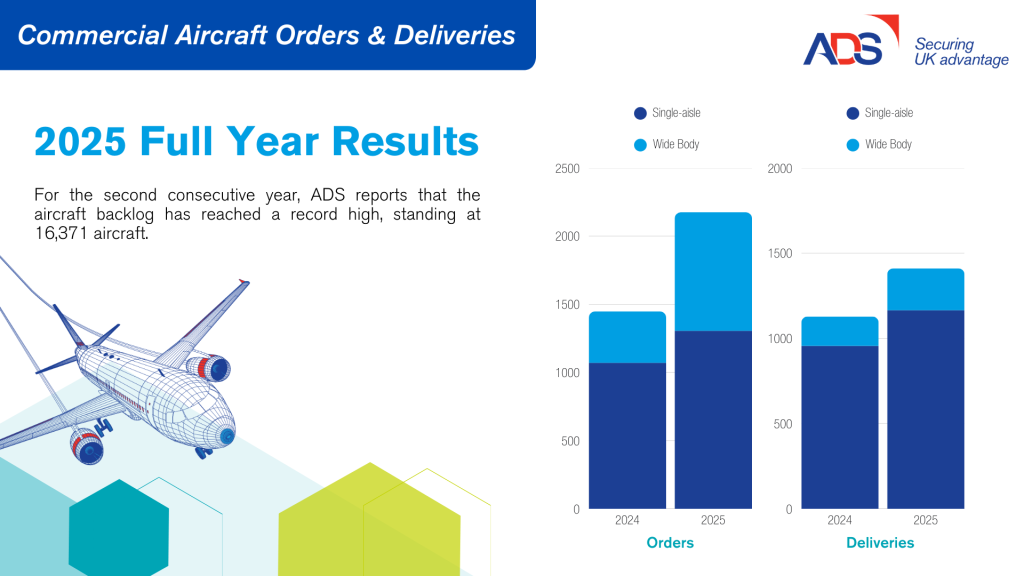
Global demand for aircraft continues to outstrip the industry’s ability to produce them. According to ADS, UK trade association for aerospace, defence, security and space, the backlog reached a record high of 16,683 aircraft at the end of April 2026, up 5% year-on-year. At current production rates, that represents around 12 years of work and is estimated to be worth between £335 to £385bn to the UK economy.
Orders continue to land, with more than 730 aircraft ordered in the first four months of 2026, a third higher than the same period last year. This follows a strong 2025 that saw 2,175 orders, driven in part by a resurgence in widebody demand.
As the industry prepares for the Farnborough International Airshow (FIA) in July, it remains too early to say whether this year’s event will match or exceed the 260 aircraft orders generated during FIA 2024. However, organisers have had to add a sixth exhibition hall after space sold out earlier than anticipated, creating the largest footprint in Farnborough’s almost 80-year history.
Regardless of FIA 2026 order levels, manufacturers are already adjusting investment and production strategies in response to sustained demand. The pressure is driving a stronger focus on how to increase productivity rather than simply capacity, and automation is central to that shift, says Harriet Wollerton, Services Director at ADS.
“We are clearly seeing increased interest in automation,” Wollerton continues, noting that the interest is a result of necessity rather than opportunism. “SMEs are recognising that traditional scaling models won’t deliver required build rates, and automation is seen as essential to remain competitive and secure future aerospace work.”
Mike Wilson, Chief Automation Officer at the Manufacturing Technology Centre (MTC), agrees, saying it is impossible to significantly increase production rates without far greater use of robotics and automation. “The key factor is competitiveness, particularly in the supply chain. If we do not improve productivity, businesses won’t be competitive, and components will be sourced overseas.”
Unlocking capacity
ASG Aerospace has been steadily automating processes for several years. Formed in 2019, the group brings together eight companies with specialisms across engines, wings, rotorcraft and fuselages, supplying some of the biggest names in aerospace. It operates more than 180 CNC machine tools and employs over 470 employees, both figures continuing to grow through ongoing investment and an active acquisition strategy.
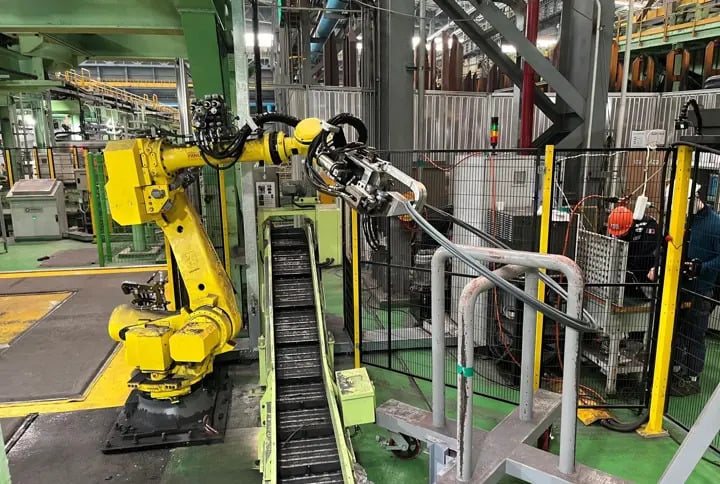
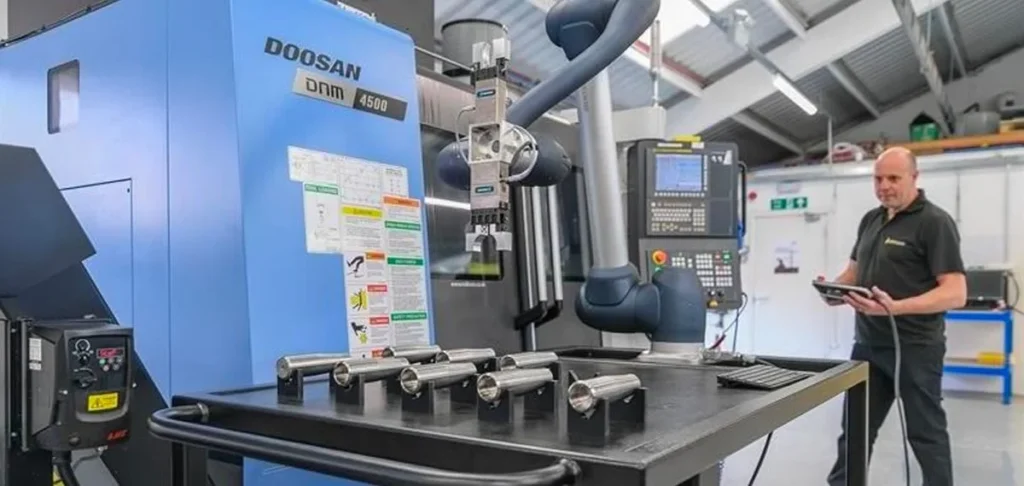
At ASG Arrowsmith Engineering in Coventry, more than £200,000 has been invested in a Doosan 4-axis machining centre and robotic cell, delivering a 15% productivity gain and 50% capacity increase. The ‘lights out’ cell runs 24/7, producing more than 200 precision engine parts a month destined for Spain and the US. Introducing robots has meant one machine can do the work that used to require two, freeing up the second machine for new work. The collaborative robot (cobot) may be the company’s first such investment, but Managing Director Jason Alridge sees it as the start of a sustained investment drive in automation.
Further north, ASG TGM in Preston has focused on gaining the ability to deliver large, complex components at scale. Responding to rising demand from aerospace OEMs, the strategy began with a large-bed Zimmermann 5-axis machining centre, installed as a part of a £1.3m investment, enabling the manufacture of large, high-accuracy components in a single set-up, reducing risk, improving repeatability and opening access to work that other suppliers cannot accommodate.
“The Zimmermann changed the scale of what we could offer,” says Managing Director Sarah Stephens. “It allows us to compete for complex structural work where accuracy over long machining lengths is critical.”
That investment formed the basis for further expansion in long bed machining, including three new £500,000 Mazak 5-axis machining centres with intuitive ‘conversational’ programming and 30-position automated tool changers. Each machine offers a three metre by one metre working envelope, a perfect match for the large titanium and aluminium aero-structures the business now takes on, says Director Dan Hall. “It allows us to achieve geometries and tolerances that simply weren’t possible before.”
Elsewhere in the group, ASG AMF Engineering has placed robotics at the heart of its new automated thermal spray and cleaning facility. And in Yorkshire, ASG Produmax has used automation to optimise production lines and help maintain competitiveness against low-cost international players.
Beyond robotics
Physical automation is only part of the response, however. Alongside robotics and machine tools, suppliers are increasingly adopting digital automation to improve how production is planned, carried out and controlled.
Grainger & Worrall has invested heavily in both areas. The Shropshire-based precision casting specialist has incorporated robotic solutions and 3D vision technology to improve accuracy and throughput. One example is a precision handling system built around a KUKA KR300 robotic arm, which has increased efficiency and workplace safety while reducing manual errors.
Having secured more than £30m of new orders across aerospace, defence and energy in the first half of 2026, the company has announced a £1m investment programme to expand its use of Digital Sand Printing (DSP). “The parts being demanded by primes today are more intricate, more performance-critical and more tolerance-demanding than ever before,” says CEO Duncan Eldridge. “Meeting that challenge requires deep materials expertise, advanced process technology and the kind of hard-won engineering knowledge that takes decades to accumulate.”
Unlike conventional tooling methods, DSP enables complex CAD geometries to be translated directly into castings with intricate internal flow paths and features that would otherwise be difficult or impossible to manufacture. The latest investment will increase capacity for complex, high-integrity castings and reduce lead times from design to finished cast part to as little as four to six weeks. For aerospace customers, Eldridge believes this fundamentally changes the design conversation, allowing engineers to focus on performance rather than the limitations of traditional casting processes.
“We are casting components today with internal geometries, exotic alloys, and tight dimensional tolerances that would have required entirely different manufacturing approaches a decade ago, often at far greater cost and significantly longer lead times,” he says.
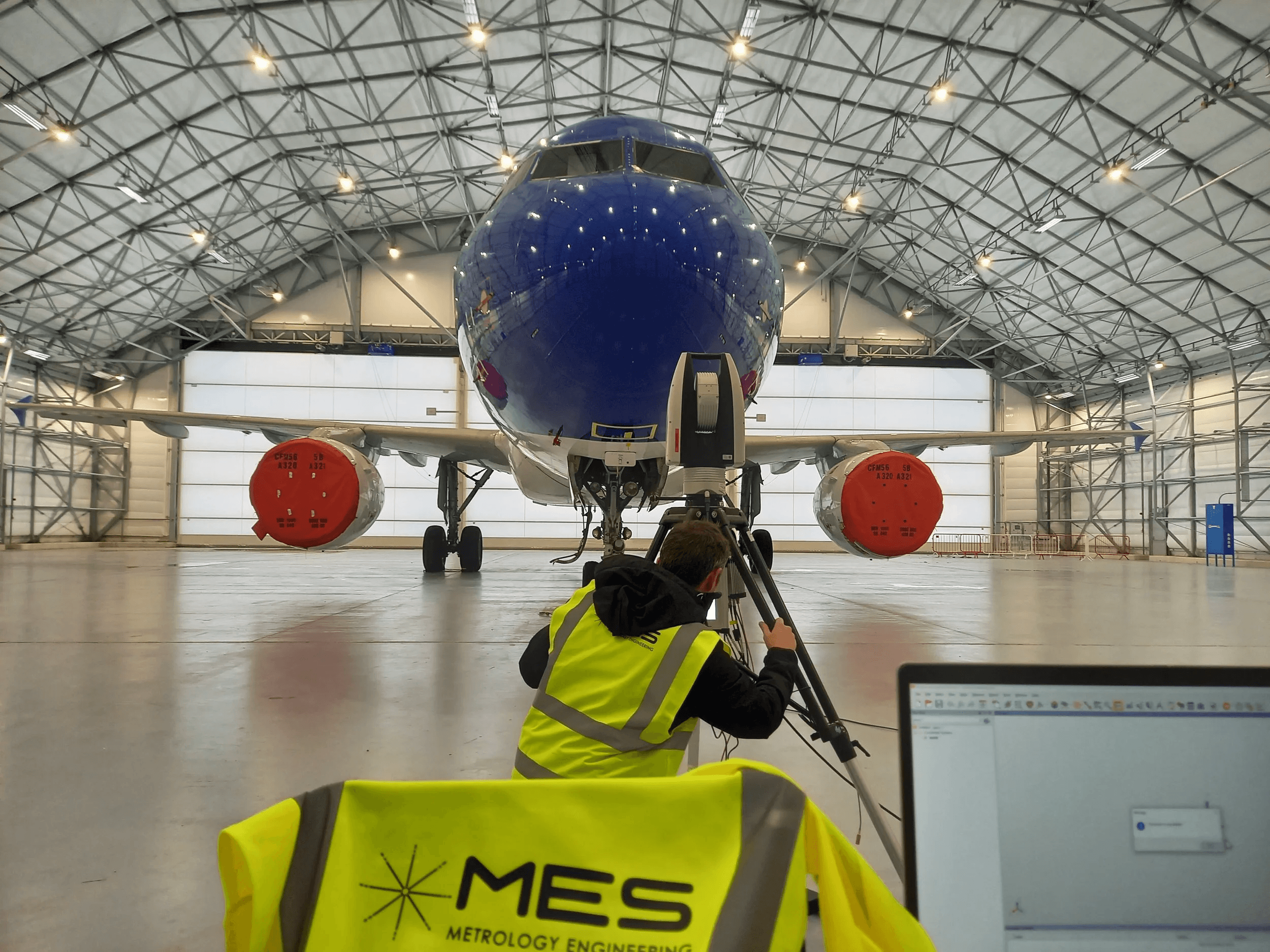
The focus on automation isn’t confined to new aircraft production. In the maintenance, repair and overhaul sector, Welsh firm Metrology Engineering Services (MES) has adopted advanced digital scanning technology, supported by a SMART Flexible Innovation Support grant from Business Wales, to replace manual inspection processes.
Following a major hailstorm in Europe, MES used 3D digital scanning to create detailed models of damaged aircraft components, enabling repairs to be assessed and completed more quickly. By repairing rather than replacing parts and returning aircraft to service sooner, the approach reportedly saved a major Middle Eastern airline more than $20m. The company has since expanded into digital asset management using AI and blockchain technologies, highlighting the growing role of digital automation across the wider aerospace ecosystem.
Encouraging adoption
Contrary to common perception, automation is not reducing the need for people, but helping deploy skills more effectively. As MTC’s Mike Wilson says, “We currently have shortages of both labour and skilled labour. If we’re looking for growth, we need to ensure existing labour is applied as effectively as possible, using their skills to add value to products. Any other tasks, particularly those that are repetitive, should be considered for automation.”
A growing number of companies have reached the same conclusion. Graninger & Worrall is currently recruiting 30 new employees across manufacturing, maintenance and quality as it scales up to meet demand. For Eldridge, technology investment and workforce growth are complementary rather than competing priorities.
While automation is helping to increase throughput and tackle increasingly complex engineering challenges, it also creates a need for engineers who can programme advanced machine tools, interpret tomography data and work confidently at the intersection of materials science and digital manufacturing. “Technology and talent are not in competition; they are mutually reinforcing,” he says. “Workforce growth alone won’t be sufficient.”
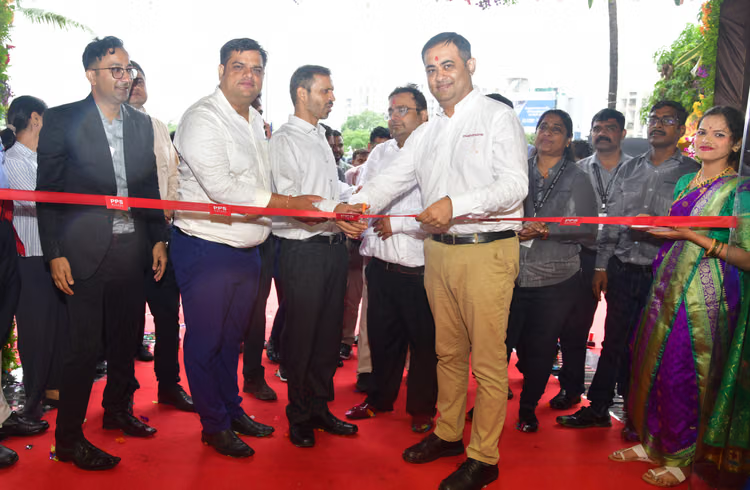
The more immediate constraint for the supply chain, however, is adoption capability. For SMEs in particular, barriers around cost and understanding how and where to begin continue to slow uptake, even where the business case is strong. To address this, the MTC has opened a new Robot Experience Centre at its Ansty Park site. Designed to help businesses with no experience of automation, the vendor-neutral facility allows a space to explore, test and validate solutions before committing to investment.
The centre brings together configurable robot cells, demonstration environments and collaborative development spaces, alongside training and guidance on building business cases and defining technical requirements. It also connects manufacturers with finance providers and system integrators to move projects from concept to deployment.
For Wilson, the aim is to reduce friction at every stage of adoption. “By giving businesses access to testbeds, expertise and training under one roof, we’re helping them make investments that improve productivity, strengthen competitiveness and support long-term growth for UK manufacturing,” he says.