SEMICON® India 2025 Sets Historic Milestones, Strengthens Global Collaboration, and Showcases India’s Semiconductor Vision!
By Ashutosh Arora
SEMICON® India 2025, the flagship exhibition of India’s rapidly growing semiconductor industry, concluded on a high note in Bengaluru, marking a watershed moment for the country’s ambition to become a global hub for semiconductor innovation, manufacturing, and talent. The event not only doubled in size compared to last year but also set new benchmarks for international participation, government-industry collaboration, and technology showcases.
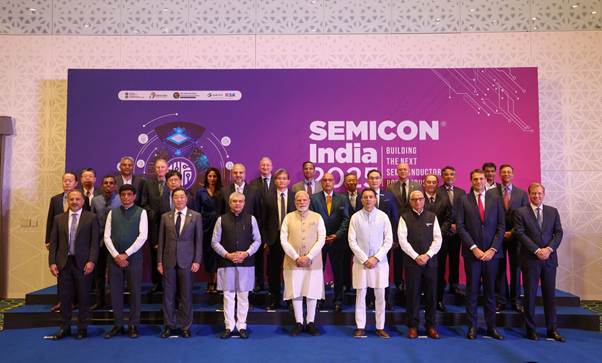
The highlight of the exhibition was the visit of Prime Minister Narendra Modi, who toured the exhibition floor, engaging directly with global CEOs, innovators, and Indian startups. Accompanied by Union Minister Ashwini Vaishnaw, Minister of State Jitin Prasada, and S Krishnan, Secretary of MeitY, the Prime Minister reaffirmed the government’s determination to establish a world-class semiconductor ecosystem in India. His presence sent a powerful message of India’s resolve to drive strategic self-reliance and global competitiveness in advanced electronics manufacturing.
During his walkthrough, Prime Minister Modi interacted with senior executives from the world’s leading technology companies, including Christophe Fouquet (ASML), Dr Randhir Thakur (Tata Electronics), Prabhu Raja (Applied Materials), Rangesh Raghavan (LAM Research), Tony Kawai (Tokyo Electron), Ahmad Khan (KLA), Gursharan Singh (Micron), Dr Mukesh V Khare (IBM Semiconductors), and Raghu Panicker (Kaynes).
SEMICON India 2025 welcomed 21,000 unique visitors, hosted 1,275 booths from 350 exhibitors, and spanned 25,000 sq meters of exhibition space. With 35,000+ attendees from 48 countries and more than 30,000 footfalls, the event transformed into a global meeting ground for collaboration, partnerships, and knowledge exchange. The exhibition also showcased four country pavilions—Japan, Korea, Singapore, and Malaysia—alongside eight state pavilions from Gujarat, Tamil Nadu, Karnataka, Odisha, Maharashtra, Assam, Haryana, and Uttar Pradesh. These platforms highlighted regional strengths, policy frameworks, and investment opportunities in India’s evolving semiconductor landscape.
At the Startup Mitra Pavilion, Prime Minister Modi interacted with young founders spearheading India’s design-led semiconductor revolution. Innovators such as Vrinda Kapoor (3rd iTech), Pratap Narayan Singh (Vervesemi Microelectronics), Gautam Kumar Singh (Fermionic Design), Anantha Kinnal (Calligo Technologies), and Jyothis Indirabhai (Netrasemi) presented cutting-edge chip design solutions for strategic, industrial, and consumer applications. Their work underscored India’s growing strength in IP-led semiconductor design and system innovation.
The event floor featured a wide spectrum of breakthrough technologies, from plasma and edge bead removal (EBR) tools for next-generation chip manufacturing to Digital Twin platforms that allow real-time simulation and optimization of semiconductor equipment. Demonstrations of AR glasses illustrated how immersive technologies are redefining equipment servicing, training, and maintenance. Adding to the futuristic experience, visitors were captivated by a life-sized replica of IBM’s Quantum System Two chandelier, symbolizing India’s entry into the quantum era. A state-of-the-art semiconductor chamber cleanroom was also presented, highlighting India’s readiness for advanced chip fabrication.
Reflecting on the success of the event, Ashok Chandak, CEO & President of SEMI India and IESA, stated: “The Prime Minister’s direct engagement with CXOs, startups, and international delegations has reinforced India’s resolve to become a global semiconductor powerhouse. SEMICON India 2025 has set new benchmarks for collaboration and investment. We are confident that SEMICON India 2026 will build further on this momentum, driving innovation, self-reliance, and global partnerships.”
SEMICON India 2025 not only celebrated India’s progress but also outlined a bold roadmap for the future. By bringing together policymakers, global technology leaders, academia, and startups under one roof, the exhibition showcased how India is fast emerging as a trusted destination for semiconductor design, manufacturing, and innovation—laying the foundation for a resilient, future-ready digital economy.