
Navigating Milling Challenges: Understanding Vibration in CNC Machining
The advent of CNC technology for machining centers brought about a digital revolution, where part designs are crafted in CAD software and tool paths are generated through CAM software. However, while digital precision is paramount, overlooking physical realities, such as vibration during the milling process, can compromise manufacturing efficiency and part quality. This article delves into the impact of vibration on milling operations and its implications for achieving optimal results.
In the realm of discrete part manufacturing through milling, the digital workflow typically involves the following steps:
- Designing the part using CAD software.
- Selecting cutting tools for material removal.
- Generating tool paths using CAM software based on the CAD model.
- Executing material removal to achieve the desired geometry.
While these steps seem straightforward in the digital domain, they intersect with the physical realm, where various factors can disrupt the machining process. Issues such as machine tool positioning errors, tool wear, and excessive vibration can arise, affecting machining accuracy and surface finish.
Tool wear is a common concern, influenced by factors like cutting speed, material properties, and coolant application. Meanwhile, vibration, induced by cutting forces, presents a significant challenge. Cutting forces cause tool and workpiece displacements, leading to chatter, a self-excited vibration phenomenon that can deteriorate surface finish and damage tools and machinery.
Understanding the dynamics of vibration is crucial. Cutting tools, designed for stiffness, still exhibit deflection when subjected to cutting forces, akin to a spring-like behavior. Additionally, workpieces may also flex, amplifying vibration effects. The variable cutting force, influenced by chip thickness and width, contributes to dynamic tool and workpiece displacement, resulting in vibration during milling.
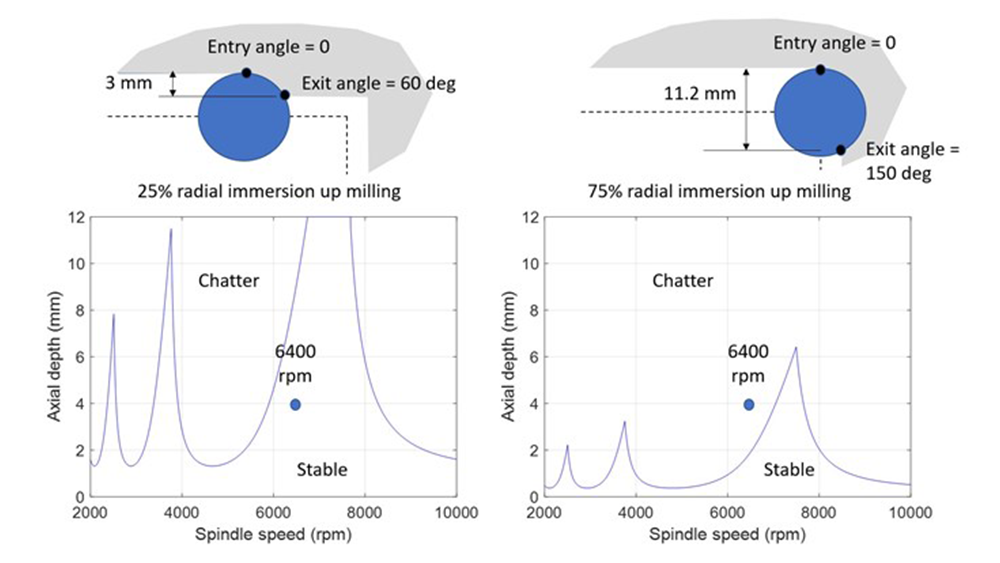
To mitigate chatter and ensure stable machining conditions, it’s essential to consider the tool tip frequency response function and radial depth of cut from the tool path. Stability maps, derived from these parameters, aid in identifying spindle speed-axial depth combinations conducive to stable machining. By integrating vibration considerations into CAM milling parameters, manufacturers can streamline the process planning stage, minimizing trial-and-error iterations and optimizing machining efficiency.
In conclusion, acknowledging the impact of vibration on milling operations is paramount for achieving consistent, high-quality results. By incorporating vibration analysis into the machining workflow, manufacturers can enhance productivity, reduce machining errors, and elevate overall manufacturing performance.
Original source MMS