
08:24
🎧Innovation fit for a King

In AML’s digitally enabled ‘war room’ the firm’s co-founder and Managing Director, Gareth Morgan, is discussing the good news with his colleagues: the 100-strong precision engineering team has just won the coveted King’s Award for Enterprise Innovation. The award recognises ‘leaders in their field who adopt exemplary working practices and inspire other businesses.’ It’s one of the UK’s highest accolades for business excellence.
Fittingly for an MTD aerospace issue, the award is in recognition of AML’s ability to apply technologies and lean processes more often seen in the automotive sector to unlock a staggering two-fold productivity increase in the aerospace sector: enabling a leading UK jet engine manufacturer to expand into the lucrative business aircraft market which is expected to grow to $36.4bn by 2030.

“We are all so proud of what we have achieved and that our skills and talents are recognised at the highest level. It sends a powerful message to our customers that we are constantly seeking better and smarter ways of delivering products to three sectors that are critical to the success of UK Plc – energy, aerospace and defence,” says Gareth, who established the company as a spinout from the Advanced Manufacturing Research Centre (AMRC)16 years ago.
The engines for this market require many novel design elements, materials and technologies to achieve the necessary performance levels demanded by manufacturers, regulators and governments. But behind every challenge, lies an opportunity.
“This combination of high demand and high technological requirements for an existing customer presented an opportunity for AML to develop a new aerofoil manufacturing process that meets the stringent demands of the next generation of business aircraft engines. This opportunity drove the subsequent R&D to develop this innovation project,” Gareth said.
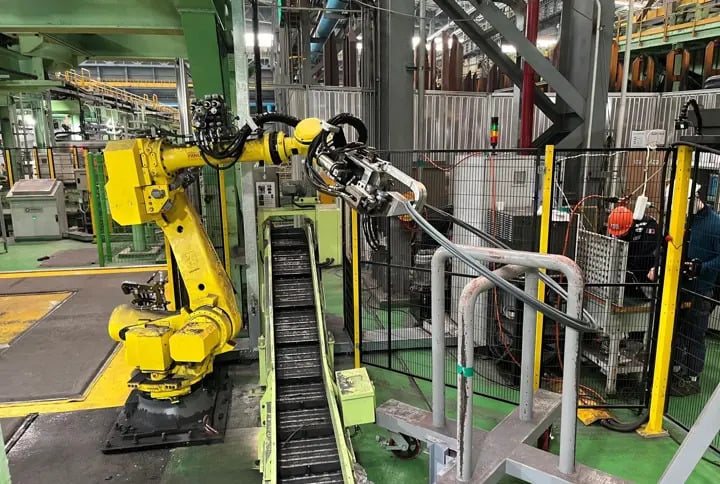
“Our success in delivering this innovation has accelerated our growth by creating eight new roles – six machine operators and two manufacturing engineers – supporting the new robotic production cell built to manufacture these components. Several employees working on the cell have been trained to program and operate it, extending their knowledge and experience,” says Gareth, proving that robotics can increase the demand for skilled roles, rather than remove them.
Gareth acknowledges the role that others have played in helping the embryonic AML go from two co-founders and £90,000 turnover in 2008, to a 100-plus workforce and a turnover of £11m and growing today.
In the case of the King’s Award, he pays special tribute to the Aerospace Technology Institute (ATI) which, over the last decade, has invested £3.6bn in UK manufacturing in “a long-term plan to produce more than 400 cutting-edge aerospace R&D projects across the UK, driving world-class research in sustainable aviation and supporting thousands of jobs”.
Funding from the ATI for the Automotive Excellence in Aerospace (AXIS) project, along with R&D support from former colleagues at the nearby AMRC were critical in giving Gareth and his team the financial and technical support they needed to turn this challenge into an opportunity.

As with all innovations, this required a venture into the unknown. For AML it meant the adaptation and deployment of robotics using advanced automation simulation tools. It also required the development of a bespoke clamping design, which illustrates the value of having a world-leading R&D partner on your doorstep in the shape of the AMRC’s automation experts in Factory 2050.
“Working with the AMRC gave us the confidence to be bold as they have R&D strengths in both precision machining and robotics in the aerospace sector. Having such talent on the doorstep gives us a huge advantage as a business,” said Gareth.
It is also a reason why South Yorkshire is consolidating its reputation as global player in the aerospace, energy and defence sectors, which was recognised as it is the first Investment Zone in England with a focus on advanced manufacturing. This has been accompanied by an announcement that ATI is investing close to £30m in the AMRC-led COMPASS project to accelerate composite aerostructures with Boeing and Spirit AeroSystems.
For Gareth, the big message to government is that ATI’s long-term strategic R&D funding is key to expanding what UK aerospace OEMs and their supply chains can achieve when manufacturers have a public sector partner with a consistent vision for the sector and the financial firepower to fund innovation projects.
These investments, all match funded by the private sector, are essential to maintaining the UK aerospace industry’s position with a staggering 70% of domestic aerospace production being exported around the world.

As thousands gather for the Farnborough Air Show it is also worth reflecting that the sector directly employs 108,000 people and supports over 5,200 apprenticeships across the UK: delivering high-value jobs for a highly skilled workforce. The UK exports £18.6bn with a turnover of £27bn last year.
AML, and innovative supply chain firms like them, are key to the UK retaining its position as a leading player in this global market. But they are also key to driving inclusive economic growth in the regions and nations of the UK. The success of firms like AML shows that regions don’t need a major OEM to drive innovation and growth.
“You don’t need to produce or innovate the complete product to unlock a significant profit share of the final sale. It’s the same in tech. Ask HP or Dell whether it is them or Samsung and Intel who enjoy the best profit margins when a consumer buys Dell or HP computers?” Gareth said.
AML is now a digitally driven tech business. Cloud-based data analytics informs everything they do. But getting there required support. For Gareth, this meant engaging with what he describes as the ‘brilliant Sharing in Growth programme’ whose vision is ‘growing great businesses, by developing great people, for this generation and the next.’
“Our war room is the result of that collaboration giving us the manufacturing equivalent of the Starship Enterprise flight deck. No more Monday morning mayhem where people spend hours sifting through data, turning it into graphs and charts. It’s all there in real-time dashboards, freeing us to interpret the data and make much better, informed decisions.”
But digital is not confined to the war room, it runs like a thread through the whole business: from its extensive quality management system to its adaptive machining algorithms that enable AML to achieve the tightest of tolerances across a range of materials from titanium and nickel-based superalloys, to softer alloys such as aluminium.
For the King’s Award-winning project AML developed bespoke algorithms to generate efficiencies and ensure that each component’s features perfectly blend with the other components’ surfaces, increasing manufacturing performance and reducing rejected parts.

But not every innovation is entirely high-tech. As part of the ATI-funded project, AML looked to the centuries’ old manufacturing technology of forging to deliver big savings in time, energy and cost. This required collaboration between Redditch-based forging specialists, Mettis Aerospace, the AMRC and AML to overcome many hurdles, making this a fully integrated manufacturing process that provided consistency throughout the whole manufacturing chain.
The lesson from this for policymakers and manufacturers is the need to identify niche capabilities in fragmented global production supply chains that open up new markets and products. But broad economic surveys of regions and sectors alone will not reveal where these gaps and opportunities can be found – that requires real manufacturing intelligence-gathering activity.
As AML’s success demonstrates, innovation can have a major impact on productivity. And productivity, which has flatlined in the UK since the 2008 financial crash, is what drives wealth creation, economic growth and personal prosperity.
Back in the war room, Gareth reflects on the importance of being part of the bigger advanced manufacturing cluster or innovation district taking shape in South Yorkshire. For him, it puts fast-growing companies like AML on the global stage. As Gareth says: “AML doesn’t win it on its own, it wins it by being an integral part of this growing advanced manufacturing cluster. If you’re going to compete globally, then you have to be part of a bigger team. When we are successful that means a win for AML is a win for South Yorkshire and a win for UK plc.”