

Texas Instruments Showcases Energy-Efficient and Smart Semiconductor Solutions at electronica India 2025!
By Ashutosh Arora
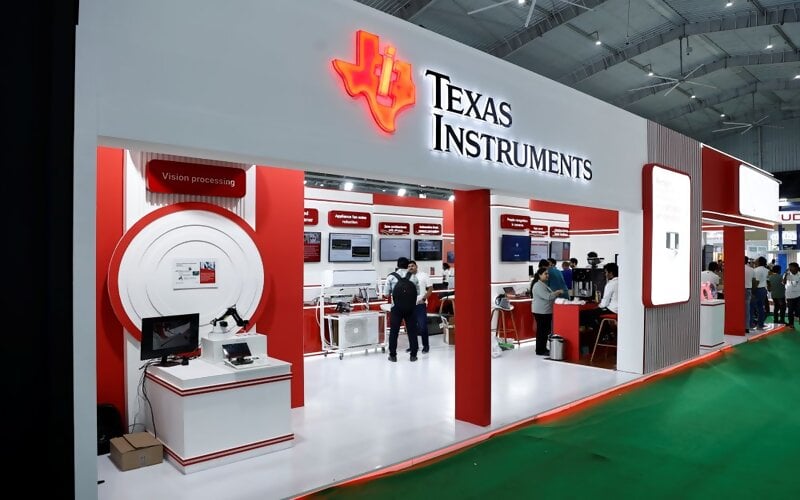
Texas Instruments (TI), a global leader in analog and embedded processing semiconductors, is presenting a comprehensive range of innovations at electronica India 2025, held from September 17–19 at the Bangalore International Exhibition Centre (BIEC). At its exhibit in Hall 3, Booth D11, TI is highlighting how its technologies are enabling smarter, more energy-efficient, and secure systems across sectors such as energy infrastructure, automotive, and connected appliances.
Santhosh Kumar, president and managing director of TI India, framed the company’s presence at the event as part of a larger mission. “At electronica India 2025, TI is showcasing how our latest semiconductor innovations are enabling energy-efficient, smart and secure solutions that are essential for building a more sustainable future,” he said. “TI’s comprehensive portfolio of analog and embedded semiconductors, combined with our industry-leading technologies and system-level expertise, enables customers to design intelligent systems that are accelerating energy savings at scale across industries.”
Among the highlights is the new F28E120SC microcontroller (MCU), which is featured in live demonstrations illustrating real-world applications. One demo shows noise reduction in appliance fans by controlling a high-voltage three-phase motor through a harmonic distortion reduction algorithm—an approach that can improve HVAC efficiency. Another demo showcases high-speed sensorless motor control in vacuum cleaners using field-oriented control (FOC) software. This allows for smooth startup, reduced peak currents, and efficient operation. Visitors can interact with the system to spin the motor at speeds of up to 150,000 rpm, providing a tangible demonstration of TI’s technology in action.
In the electric mobility space, TI is demonstrating solutions that combine compact design with high efficiency. A 750W light electric vehicle charger powered by the UCC25661-Q1 LLC controller is on display, aimed at e-bikes, scooters, and other light EVs. With TI’s patented input power proportional control (IPPC) technology, the charger maintains stable operation even when batteries are nearly depleted. Complementing this is an 11kW compact EV charging system driven by a single F29x C2000 MCU. By combining high- and low-voltage power conversion in a single stage, it achieves an impressive 97.6% efficiency while delivering 5.5kW of power per liter, making faster charging possible in a smaller, cost-effective unit.
Battery safety and reliability are also a focus, with TI’s high-voltage battery management system (BMS) showcased as a solution for large battery packs. This platform integrates hardware and software tools to accelerate development, helping manufacturers bring safer and more dependable energy storage systems to market more quickly.
Beyond power and mobility, TI is highlighting innovations in connectivity and consumer electronics. Edge AI audio technology, with wake-word detection running on the CC3551 wireless MCU, leverages Sensory’s TrueHandsfree™ library to support voice-activated interfaces. The company is also exhibiting compact 65W gallium nitride (GaN)-powered adapters equipped with dual USB ports. These offer high power density in a portable, space-saving design, aligning with consumer demand for efficient and reliable charging solutions.
Texas Instruments, traded on Nasdaq under the symbol TXN, has long pursued a mission to make electronics more reliable, more affordable, and more energy-efficient. The company designs and manufactures semiconductors that power applications across industrial, automotive, personal electronics, enterprise systems, and communications. At electronica India 2025, TI’s demonstrations emphasize how each new generation of technology builds on the last, driving sustainability and enabling smarter products at scale.
With India emerging as both a key market and a hub for global electronics manufacturing, TI’s showcase underlines the role of semiconductor innovation in shaping the next era of energy-efficient and intelligent systems.