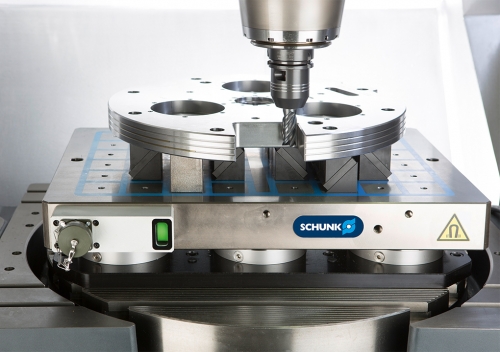
The permanently activated magnetic clamping technology is considered as a pros tip when it comes to reducing the equipment time and clamping with small deformation of the workpieces. With a certain design finesse, it is even possible to tighten large components without deformation in a matter of seconds and machine them from all five sides. In the field of standard modules, development activities are not left behind: modern magnetic chucks provide visual or automated monitoring of the tightening process.
The secret of clamping parts without deformation by means of a magnet lies, on the one hand, in the mobile pole extensions and, on the other hand, in the optimization of the collision contours. Like a water bed, the mobile pole extensions are flexibly attached to the workpiece, in the case of electrically activated square-pole plates, and compensate for the irregularity of the parts in the machine. first assembly. In this way, it is possible to clamp ferromagnetic blanks without deformation and machine them in one operation from five sides. In the second assembly, it is possible to obtain a fineness of room that can not be obtained with another mechanical clamping device: in practice, it is not uncommon to achieve plane parallelism up to 0.02 mm. Unlike conventional fixtures with gripping jaws or gripping claws, punctual damage and deformation of parts are avoided. Users even benefit from maximum clamping precision and realistic workpiece fineness. This advantage is important especially with large steel plates or other workpieces sensitive to deformation. Clamping on a large surface minimizes vibration and protects the machine spindle and sharp edges. The operation is very simple: the ferromagnetic workpiece is placed on the top, and the magnetic mandrel is activated by a short electrical pulse. In a matter of seconds, the
Magnetic chucks indicate tightening condition
SCHUNK shows the way with its MAGNOS square-pole plates: all the standard plates in the catalog program are now equipped with a patented status display by default, which permanently indicates the tightening status. course – even if the magnetic chuck has been decoupled from the control system. SCHUNK thus contributes enormously to the elimination of operational errors during daily operations and optimizes the reliability of the processes. The machine operator has full control whether or not the magnetic chuck of the machine table has been activated. The other striking feature is that the higher the degree of automation, the more magnetic chucks are pre-equipped and stored as pallets in the workbench. Thanks to the screen,
Automated clamping process
SCHUNK is also looking seriously at integrating simplified control and monitoring of clamping status with the modular SCHUNK KEH plus control unit. Depending on the basic version, one, two, four or eight square or radial pole plates can be controlled – either directly or using terminal boxes via the control unit. The control unit provides information on the current clamping status of the magnetic chucks at all times. A 16-step force control process helps align workpieces and clamps thin components. Magnetic chucks can also be operated in automated applications by means of a 78-pin PLC controller connection directly from the machine control system. To ensure the reliability of the process, it is possible to develop a detailed monitoring of each magnetic mandrel. For this, the individual clamping state is transmitted to the system control via a PLC interface. The SCHUNK MAGNOS HABE KEH plus remote control, in turn, allows manual and practical control of up to eight magnetic chucks, as well as their respective 16-step holding force control modes. The control continuously transmits to the operator information on the individual tightening state of the magnetic clamping plates connected via the LCD display and an LED. The anomalies are presented on the screen in the form of error codes.
Application to simulate clamping
Thanks to an application that SCHUNK will soon be offering for iOS and Android, registered users can simulate different clamping situations on SCHUNK MAGNOS square or radial poles without load. This is done by entering basic data about the workpiece, the cutting parameters and the type of magnetic mandrel; the application quickly determines whether the holding forces are sufficient for machining. With the digital tool, SCHUNK makes it possible to evaluate machining operations very quickly. In addition, users can use the potential reserves of magnetic clamping technology.
Smart magnetic chuck with force measurement system
Technological studies of the SCHUNK MAGNOS force measurement system are taking an important step towards intelligent manufacturing. The intelligent magnetic clamping solution automatically detects the respective position and size of the pieces on the magnetic chuck, and determines the precise individual clamping force required. This means that the system creates the necessary conditions for the continuous monitoring of the process, as well as for the automatic adaptation of the machining parameters according to the size and quality of the individual parts. It also assumes that in the future it will be possible to optimize the feedrate or cutting speed on a case-by-case basis with a large pole cover and a high clamping force, or , in the case of low pole covers or weakly ferromagnetic workpieces, it will be possible to reduce these same parameters so as to ensure a reliable machining process. Potential application areas of the system include the processing of small and intermediate batches with automated part handling, as well as machining operations that require close monitoring of the process. The system therefore paves the way for the implementation of high-end, highly transparent and flexible networked processes for Industry 4.0. Potential system applications include the processing of small and intermediate batches with automated coin handling, as well as machining operations requiring close monitoring of the process. The system therefore paves the way for the implementation of high-end, highly transparent and flexible networked processes for Industry 4.0. Potential system applications include the processing of small and intermediate batches with automated coin handling, as well as machining operations requiring close monitoring of the process. The system therefore paves the way for the implementation of high-end, highly transparent and flexible networked processes for Industry 4.0.
To compensate for deformation due to heat, these square profiles are clamped both on the base and laterally by means of a magnet. Photo: SCHUNK
The magnitude of the range of possible applications and the immense potential effectiveness of the magnetic clamping technology are illustrated by some examples from the practical applications that SCHUNK has put in place:
Example 1: Vertical clamping of XXL steel profiles
Precise machining of large-format steel profiles for welded frames, gantries or mounting devices involves considerable effort in conventional clamping: to remove material from the components, the strips must first be welded. Subsequently, the pieces are often painstakingly rewound, rewound several times and flambé after treatment. For large workpieces, for example, two operators are often required to perform the tightening process. Magnetic clamping technology greatly shortens this process.
The solution: vertically mounted SCHUNK MAGNOS square-pole plates ensure that steel profiles up to 10 000 mm long can be clamped in a flexible way without deformation. The flexible use of magnetic pole extensions makes it possible to quickly adapt the clamping solution to various diameters. For this purpose, a row of poles is simply removed or completed. The SCHUNK EASYTURN removably mounted pole extensions can be individually adjusted to different room contours and guarantee a delicate, low-deformation installation. Punctual damage or warping, common phenomena when machining long steel profiles, are completely eliminated. Even long pieces can be easily tightened by one operator. Because of the vertical mounting, the parts are accessible in the most optimal way. In parallel, the machine table is available for other machining operations without the need to remove the magnetic chucks.
Example 2: Magnetic clamping solutions for the production of individual parts on turning-milling machines
In the manufacture of individual parts and small batches on modern turning-milling machines, magnetic clamping of parts can bring significant benefits: While contract manufacturers expect, on average, about one hour for medium-sized components for conventional equipment with clamping jaws, the assembly employing the magnetic clamping technology is performed within ten to fifteen minutes.
The solution: SCHUNK MAGNOS Square Pole Trays are used face up for clamping machined workpieces and face down for flexible positioning of the clamping solution on the machine table. A device plate groups the two square pole plates into a single compact system. If such clamping units are grounded at the same height directly on the turning / milling machine, it is possible to completely eliminate the interface errors. Even milled parts can be manually centered in a very short time and accurately tightened by magnetic force. Thanks to modern turning / milling machines, savings in the five-digit range can be achieved in this way because of the time savings achieved during assembly. this in the space of only one year. In addition, all five faces of the workpiece can be machined with maximum precision in a single assembly, without having to take into account the contours of cExample 3: Rail machining with magnetic pole arrangement in T
SCHUNK’s special MAGNOS solutions can be used for the manufacture of rail components to achieve multiple effects in practice: compared to conventional clamping solutions, the number of assemblies and the equipment time are reduced by more than 50%. In addition, the process safety increases because the workpiece is laid flat despite deformation due to heat, and a stable position without vibration is guaranteed during machining.
The solution: On top of the magnetic pole T-arrangement, tongues up to 6000 mm long are clamped in pairs on both the base and the side. At the same time, it is possible to clamp other workpieces on the upper horizontal section, which gives a certain creative freedom by using the magnetic clamping solution. To ensure controlled insertion of the magnetic field lines, the magnetic clamping device consists of two magnetic configurations: a pole pitch 50 flat relative to the vertical clamping on the base, and a pole pitch 70 deep relative to the horizontal clamping on the head. The actual tightening occurs during two magnetization cycles: first, the workpieces are tightened beforehand in order to make a full surface contact with the magnets along the entire length. Then, the parts are magnetized at full power, the goal being to ensure maximum magnetic saturation and to obtain, therefore, maximum clamping forces.
Example 4: Double platform clamping system for machining components in housings
During the machining of the boxed components, the assembly times are reduced by more than 90% when MAGNOS magnetic clamping technology is used. Whatever the level of experience of each operator, it is sufficient for the latter to position the workpiece and tighten. Flexibility is also optimized: to machine special parts, simply reposition the poles individually at the work point, rather than changing the entire device.
The solution: An application-specific dual-clamping system combines a MAGNOS square-pole plate on the lower level with four SCHUNK VERO-S NSE-plus 138 quick change pallet modules on the upper level. In the case of the OP10, the compensating effect of the SCHUNK MAGNOS mobile pole extensions is controlled to clamp the cast iron parts without deformation and to treat the mirrored surfaces of the quick-change clamping pins and the end faces. In the case of the OP20, the components are taken from the lower level of the double-platform clamping system, equipped with extended clamping spindles, and then clamped directly within a few seconds to the upper level, in the pallet modules. Quick change VERO-S NSE-plus 138 from SCHUNK. At each tightening, a completely finished part can be removed, and a new part can be tightened in turn. All this on a single pallet space and without the usual interruption between the OP10 and the OP20.
Magnetic clamp for machine loading
In the field of automated loading and unloading of machine tools, the importance of magnetic grippers with electro-permanent magnets has continued to grow. This is due to the high power density and energy efficiency, as well as the collision contour that is highly favorable for handling. The SCHUNK EGM series has been designed for systems with a voltage range greater than 400 V: even the smallest size (26 mm x 98 mm) of SCHUNK’s EGM-M compact unipolar clamp is suitable for handling parts that to reach 7 kg. As the magnetic surface reaches the outer edge, no collision outline needs to be taken into account. SCHUNK Bipol Bipol EGM-B bipolar forceps are designed to handle heavy and complex ferromagnetic parts with one, two or four pairs of poles presented in different arrangements. Pole extensions can be used for optimal matching to the manipulated object in question.
The SCHUNK EGM-M Magnetic Grippers are particularly compact and versatile power concentrates, which allow the collisionless and flexible handling of ferromagnetic workpieces. Photo: SCHUNK
When all the optimal conditions are satisfied, the EGM has clamping forces of between 1.2 and 22.5 kN, depending on the equipment. In addition, it is designed to support a maximum piece weight of 147 kg and a minimum material thickness of 3.5 mm. The compact SCHUNK EMH magnetic clamp has been designed for 24 V systems: since the electronics are completely installed in the clamp and are extremely easy to control by means of digital I / O, the components do not require space in the control cabinet and external electronic control system. In order to improve the reliability of the process, the clamp signals both the status of the magnetization and the presence of the part. At the same time, errors are indicated by a screen of LED display integrated into the housing. Unlike other magnetic clamps, no waiting time is required between activations, which means that high rates can be achieved. The SCHUNK EMH magnetic gripper is available in four sizes for workpiece weights up to 3.5 kg, 9 kg, 35 kg and 70 kg. For handling thin components and sheets, the holding magnetic force can be adjusted according to four parameters