Digitalisation in metal cutting in full swing
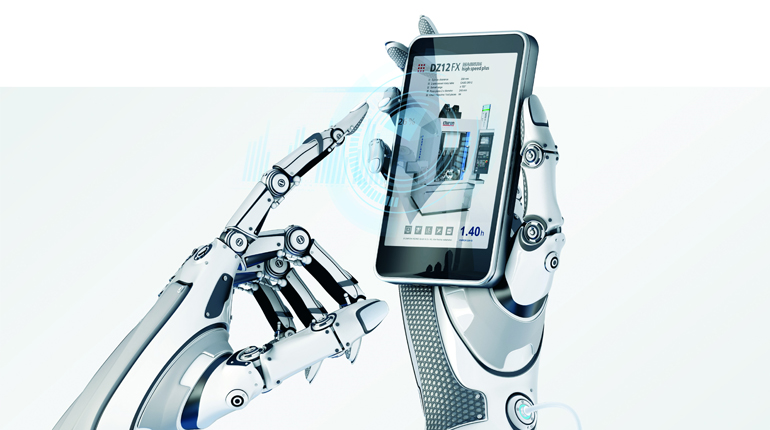
Digitalisation in metal cutting: this means that tools, clamping systems and workpieces learn something new and communicate with other components involved in the process. How does actually this function in everyday production? And will it ultimately lead to a self-optimising machine tool? Answers and solutions to these questions will be provided at the forthcoming AMB, International Exhibition for Metal Working, in Stuttgart from 18 to 22 September 2018.
There is still much room for improvement in regard to digitalisation. The Reconstruction Loan Corporation (KfW) certainly found this out during a survey that was recently conducted among medium-sized companies. Quotation: "The proportion of medium-sized companies which successfully completed digitalisation projects in the last three years, i.e. 26 per cent, is much lower than previously assumed.“
A closer examination reveals, however, that the R&D-intensive manufacturing industry, which includes machine tool construction, is slightly better off here at 31 per cent. However, this still primarily relates to investments in IT infrastructures and interfaces, as well as contacts with customers and suppliers. To date, only 19 per cent of the projects involve digitalisation of products and services.
Still, expenditure on digitalisation in 2016 amounted to just under €14 billion. By way of comparison: the investment expenditure of medium-sized companies was €3.2 billion while investments in machine buildings, fixtures and fittings, and similar amounted to €169 billion. The main problems are lack of IT skills, data security, data protection, company and work organisation, and poor quality of Internet connections. However, the KfW urgently recommends "further expansion of digitalisation in medium-sized German companies."
"Digital Way" will show how this can work
AMB, one of the five largest machine tool exhibitions in the world, will provide help in this respect. During the new Special show "Digital Way“ IT providers will specifically demonstrate how they are supporting machining production companies on the road to Industry 4.0. Through a combination of a first-class two-day Congress (18 and 19 September 2018) and an accompanying exhibition, "AMB will gain a new platform where users can obtain detailed information on how Industry 4.0 and digitalisation can be specifically implemented in production," said Gunnar Mey, Department Director for Industrial Trade Fairs at Messe Stuttgart.
Manufacturers of machines and components will also respond to the requests and concerns of visitors. For example Chiron, a supplier of turnkey solutions for metal working: "There is often still general scepticism towards data security when connecting machines to the Internet because a large number of companies are afraid that their own know-how is at risk. We take these reservations seriously and assume that we can convince these companies with our secure solutions," promised Pascal Schröder, an expert for digital solutions under the generic term "Smartline“ of the Chiron Group.
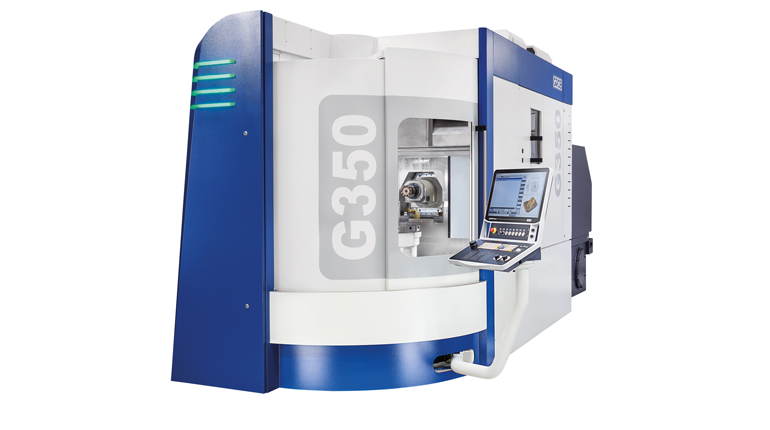
Markus Frank, Head of the Department for "Net4Industry“ at the machine tool manufacturer Grob, also said that "the German mechanical engineering industry did not jump on the Industry 4.0 or digitalisation hype in the past." However, "a substantial increase in activities and efforts has been noticeable in this area" in the last 18 months. One thing is certain: "Industry 4.0 represents the basis for operating machines and systems in a flexible and productive manner while conserving resources.“ Grob has been developing applications and solutions for networked production for more than four years and also uses them in-house.
Industry 4.0 has arrived on the shop floor
"Although the path to a self-optimising machine tool has started well, the development here is by no means over," judged Jürgen Förster, a member of the Board of Management of the clamping systems manufacturer AMF Andreas Maier. "In the end, it's always a question of communication between different media, components and systems. This should form part of the everyday work for our industry and every company should realise what contribution it can make in this case."
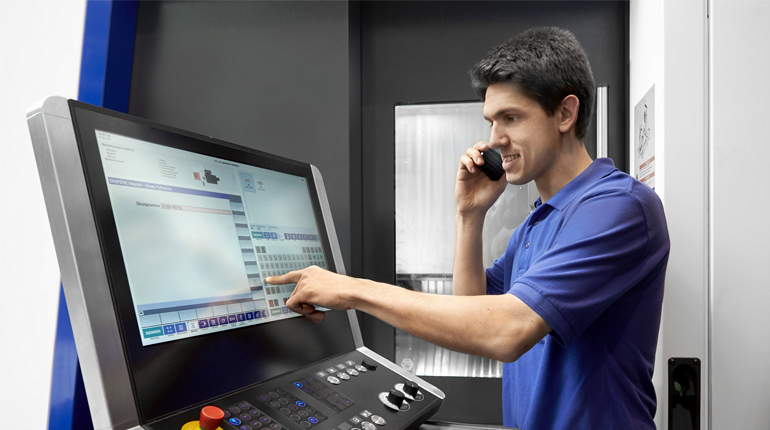
Chiron will, for example, present two new products from the Smartline family at AMB. Conditionline is a software which fully automatically analyses all machine parameters relevant to reliable operation. Schröder: "The availability of the machine can therefore be increased and maintenance and repairs can be planned precisely, thus preventing productivity losses." Chiron will also present the Touchline operating concept which will assist the machine operator, for example, with context-sensitive information.
Klaus Winkler, Chairman of the Board of Management and CEO of the Heller Group, regards Industry 4.0 as an approach to make the state of machine tools transparent at all times and evaluate acquired information with already existing data for a purposeful diagnosis. Winkler: "Under 'Heller4Industry‘ we are combining all activities relating to Industry 4.0 and digitalisation of the process chain." In addition to higher machine productivity, Heller is concentrating on support for continuous engineering chains. The core features are additional machine functions, "on demand" services and advanced service options. New developments will be presented at AMB, for example the Heller Services Interface in cooperation with Siemens.
No smart factory without networking
Networking must pay off. That is the top priority for Hansjörg Sannwald, Head of Market and Product Management for CNC Systems at Bosch Rexroth: "Solutions will only succeed if they offer real advantages." According to Sannwald, the most economical way is often through the "Brownfield approach", a concept from software development: "Machine tool manufacturers are already making further use of installed machines and systems, and are networking them retrospectively.“ For example, the IoT gateway from Bosch Rexroth can also be used to network already installed machines and systems in a cost-effective way, i.e. within a few hours by company electricians without any special knowledge of PLCs.
How are the data extracted from the machine? The clamping systems manufacturer AMF Andreas Maier relies on newly developed radio sensors. With their space-saving design, these sensors enable data on the condition of clamping systems and handling devices to be transmitted via a Bluetooth wireless connection. "The different conditions can be queried and visualised by means of our own software," explained Jürgen Förster, a member of the Board of Management of AMF Andreas Maier.
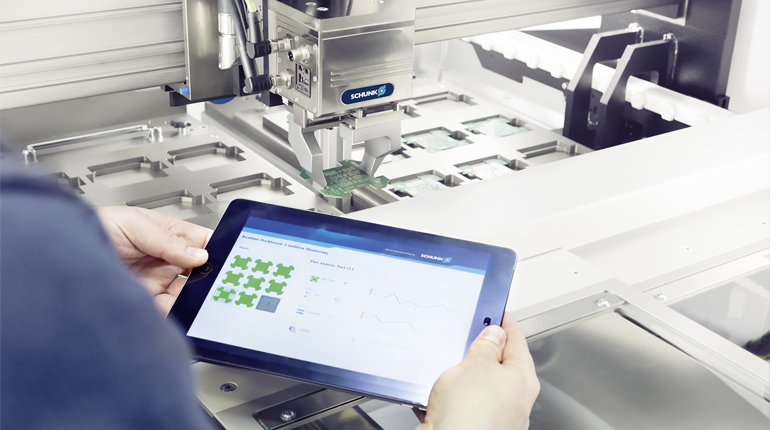
Schunk refers to the close proximity of its grippers and clamping systems to the workpiece. "We can therefore tap data directly on the workpiece and transmit them to higher-level systems," said Henrik Schunk, Managing Partner and CEO. "Smart gripping“ and "smart clamping“ provide a complete real-time production database and, thus, the necessary transparency for further optimisation of processes. During AMB the company will show how such a scenario can be implemented: for example with the smart parallel gripper EGL which Schunk has enhanced as a technology platform for smart gripping. Without any additional external sensors EGL detects defective components and decides whether to remove them from the process.
Tools also supply data
It is surprising that a large number of manufacturers of precision tools are intensively involved in digitalisation. Giari Fiorucci, Vice President Services at Mapal Dr. Kress, initially confirmed the problems determined by the KfW: the IT infrastructures, but also the quality of existing data. "Numerous medium-sized companies are currently working on projects in the direction of Industry 4.0. However, most of these projects only act as an isolated solution and do not contain any vision for extensive further development which is necessary for continuous digitalisation.“
According to Florian Böpple, Digital Manufacturing Manager at Walter, medium-sized companies actually have some aversion to Industry 4.0. He says that although metalworking companies are generally motivated, the specific benefits of the offered solution are often lacking. His conclusion: "Metal-cutting companies need practical solutions which help them to improve processes and reduce costs.“ Possibly through artificial intelligence? Dr. Jan Brinkhaus, Head of the "Digital Solutions“ Business Segment at Ceratizit, promises nothing less than "artificial intelligence abilities for the machine tool." The "Toolscope“ assistance system automatically detects, for example, tool breakages, adaptively regulates the feed rate or decouples tool data on Cloud servers. The 'Toolscope Cockpit‘ software is then used to clearly display these data and evaluate them in different ways."
It must be possible to integrate digitalisation solutions in a network as easily as possible. The interfaces between the digitalisation elements normally pose a major challenge in this case. Karl-Heinz Schoppe, Innovation & Marketing at mimatic, added: "Our eltimon product represents one approach here. As an open platform for partners and customers, it features the most important digitalisation elements. Most of the interfaces therefore become redundant.“ Eltimon will therefore be an integral part of the planned Elabo Smart Factory during the Special show "Digital Way".
About AMB
Around 90,000 international trade visitors and 1,500 exhibitors are expected to attend AMB in Stuttgart from 18 to 22 September 2018. On an exhibition area of more than 120,000 square metres, the exhibitors will showcase innovations and further developments for metal-cutting and metal-removing process machine tools, precision tools, measuring systems and quality assurance, robots, workpiece and tool handling, industrial software & engineering, components, assemblies and accessories. AMB 2018 is backed by the promotional supporters, i.e. the VDMA Precision Tools Association, the VDMA Software and Digitalisation Association, and the German Machine Tool Builders' Association
(VDW).