02:42
Toolholders were designed for mounting cutting tools reliably. They also facilitate the torque transmission from a machine spindle to a rotating tool. It has been a long time since engineers have heard of any significant changes in toolholding, which may suggest we are behind in innovation. Indeed, well-established tool clamping principles, the need for wide interchangeability and unification, and normalised designs of machine tool adaptations have resulted in well-defined standards that specify detail tool holder parameters. But this doesn’t mean that innovation and technology developments are over.
A
s time passes, new demands are put upon machining; demands that have transformed to new requirements for machine tools, and, consequently cutting tools and toolholders – both elements of a chain that enables the recognition and performance of machine tool capabilities. The tool holder relates to the most ‘conservative’ link of the chain and has undergone fewer revolutionary changes for the noted reasons. Nevertheless, time and modern trends have evolved with new innovations in metal cutting and the tool holder has not been completely left behind.
The Industry 4.0 philosophy has had a serious impact on toolholding. Smart manufacturing for tomorrows demands now sees intelligent toolholders exchange data in the newly formed Internet of Things (IoT). This will lead to the creation of new information capabilities for toolholders by adding more and more electronic units. Even today, built-in chips provide various data about a tool holder and how it communicates with machine tools, industrial robots, storage devices and more.
Adding a new data function is no doubt an extremely important direction in toolholding development. However, it does not eradicate or cancel improved mechanical designs that may look a little bit prosy when compared to the enthusiastic data intelligence of smart tooling. However, it should be noted that traditionally developed toolholders as mechanical systems will continue to advance – this progression is very far from coming to an end.
Recent improvements in tool holder designs have been distinctly seen in the following areas:
1. Heat-shrink chucks
High-speed machining (HSM) methods have brought tool balancing requirements to new heights. In HSM, the dynamic characteristics of a tool cannot be separated from a tool holder, and a particular focus must be given to the assembly of the tool and the tool holder. Hence, minimising the unbalance of such an assembly is one of the challenges tool developers face. They have tried to guarantee the required balance parameters at the design stage before production. This engineered balance design cannot replace the ‘physical’ balancing of an assembly, but it substantially diminishes the mass unbalance of a future product and makes ‘physical’ balancing much easier. Axisymmetric heat-shrink chucks optimally meet the requirements of a balanced tool holder for HSM already in the design stage. This explains why the advance of heat-shrink chucks is a priority.


2. Coolant supply
A pinpointed coolant supply through a tool body, when the coolant flow is directed to a cutting zone, significantly improves machining performance. The industry requires more advanced toolholders with inner fluid supply options, especially for machining with high-pressure coolant (HPC).
3. Modular quick-change tooling
A modular design principle considerably simplifies finding the optimal configuration of a tool assembly and diminishes the requirements for special tools.
4. Long-reach applications
Long-reach machining applications that require a long overhang of a tool assembly, features poor stability. Increasing vibration strength of the assembly is one more trend of tool holder development.
5. Polygonal taper connection
The ISO-standardised polygonal taper adaptation has proven itself and becomes common in multitasking machines and turning centres.
These are only a few of the high-profile directions for developing toolholders. The others are focused on high-torque machine tool transmission, preventing tool pull-out because of the high axial cutting force upon the component, increasing accuracy, more ergonomic solution and many more. Therefore, the conclusion of potential stagnation in the mechanical design of toolholders is incorrect. By use of example, let’s consider the newest releases of toolholding by ISCAR over the past few years.
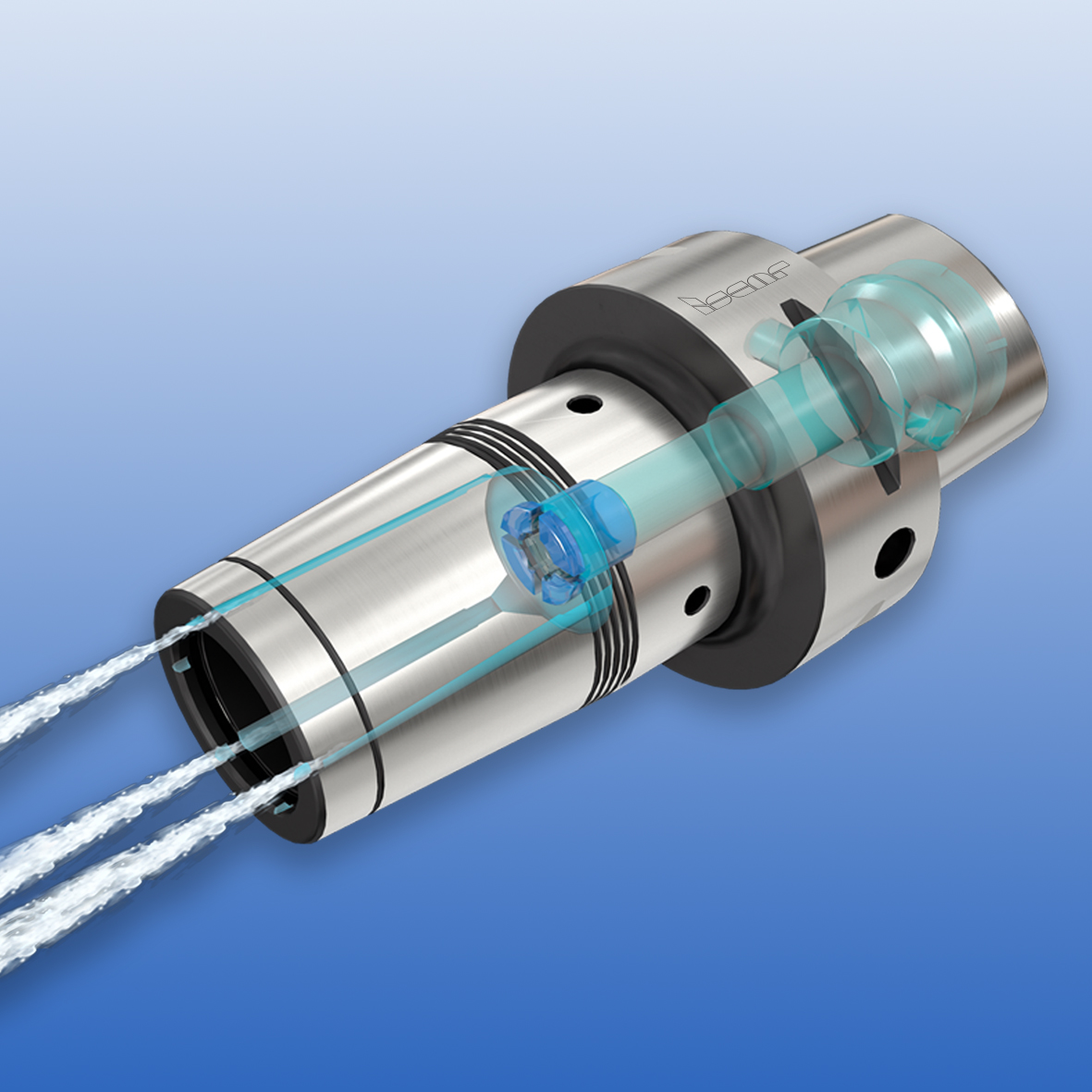
Recently, ISCAR expanded its family of heat-shrink holders by adding new chucks with a C8 polygon taper shank. The chucks offer several bore sizes from 6 to 32mm. The introduced products feature coolant channels along the chuck bore to provide effective coolant supply to the cutting edge of a clamped tool (Fig. 1).
With the increasing popularity of the polygon taper adaptation, ISCAR has developed a new tool family for external and internal turning and threading applications (Fig. 2). A modular family concept that enables various tool assemblies to be applied using a wide range of cutting heads with indexable inserts that are mounted on toolholders with polygon taper shanks by serration-face connection.
What else can be new in ER spring collets? Tool manufacturers have developed a rich variety of precision collets that offer coolant supply capability. For example, ISCAR’s new updated ER rubber-sealed collets with an extremely narrow collapse range ensure better clamping force, maintain high runout accuracy of 0.005mm and facilitate four cooling jets (Fig. 3).
ISCAR’s integral collets are tools with a tapered shank for direct mounting in ER chucks that are accurate and rigid tools. Looking at these toolholders: the front of the collet has its adaptation for mounting cutting heads with indexable inserts or they can be fully made from cemented carbides.
Hydraulic chucks ensure high gripping torque that is vital for heavy-duty machining. During recent years, ISCAR has extended its product range of hydraulic chucks and they are now available with BT-MAS, DIN 69871 and HSK shanks. In addition to high-torque transmission and fast tool-change capabilities, the hydraulic chucks are characterised by excellent vibration damping properties and accuracy.
ISCAR developed a system of quick-change assembled tools specifically for turning aluminium wheels. A tool assembly comprises a cutting head and a holder. The head is mounted on the holder by use of a dovetail connection. The dovetail mechanism assures full-face contact between the holder and the head with very high clamping forces that can resist tough cutting conditions when turning the wheels. The holders are produced with VDI40, VDI50 or round shanks (Fig. 4).
We can see that progress in toolholding is far from exhausting the resources of advanced design. Although high-quality toolholders have reached the right level of performance to meet the needs of today’s manufacturers, the smart factory of tomorrow demands an even higher level. Intelligent design, in combination with progressive technology, continues to play a key role in toolholding improvement.