02:42
🎧Kennametal revs up innovation with 3D printed tools
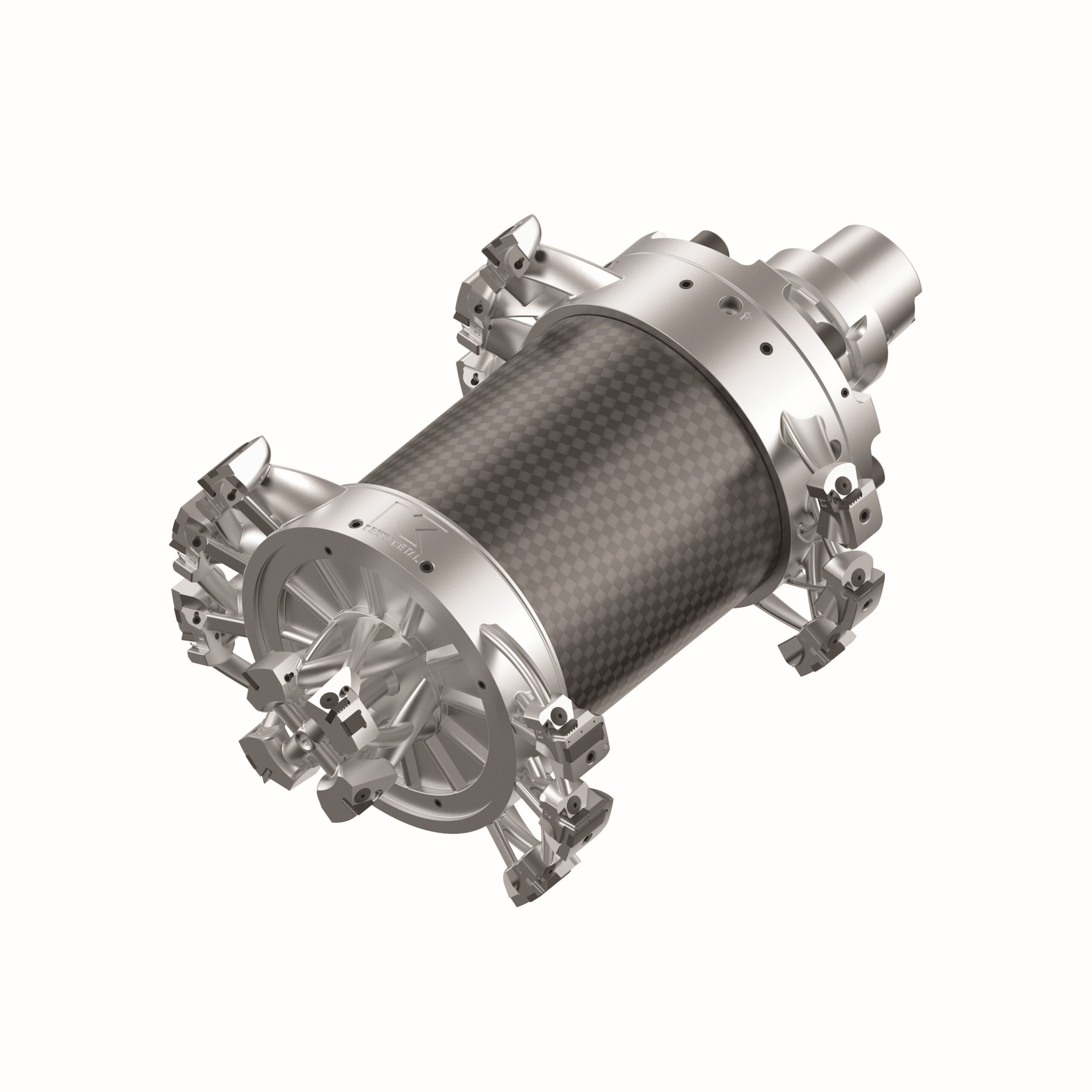
Building on the success of their award-winning 3D-printed stator bore tool for electric vehicle machining, Kennametal has developed an innovative 3D-printed transmission housing tool for Voith that cuts weight by approximately 45% and reduces machining time by approximately 50%.
As transportation components become increasingly more sophisticated and the requirements more stringent, manufacturers need complex tooling solutions to machine those components. That poses a challenge as the weight of such tooling can become too heavy for efficient operation on machining centres, tool changers and tool magazines. Machine operators may also have difficulty managing the tool.
A recent collaboration by Kennametal, an industrial technology leader, and Voith, a leading supplier of drive technologies, shows how 3D printing offers a pathway to novel, lighter-weight tooling solutions that overcome these challenges while improving productivity and efficiency.
The Challenge: Machine multiple, tight tolerance, large diameter bores with
existing machining centres
Voith wanted an innovative solution to optimise its machining processes for transmission housings further. To achieve the required tolerances, the company needed a multi-stage tool capable of machining multiple bores in one operation. The tool also needed to have two effective cutting edges on the main diameters to achieve the specified cycle time. Finally, the tool had to weigh less than 12kg to meet the requirements for tool changing and tilting moment on the toolchain.
“Finish machining a large aluminium housing with multiple bores up to 350mm and IT7 tolerance grade is a demanding application,” said Werner Penkert, Manager of Product Engineering. “To machine these large bores with such tight tolerances, we need very rigid tools, which typically means they are heavy weight. When manufactured using conventional methods, a typical tooling solution for this type of application could weigh as much as 25kg, which is too heavy for the existing machines or for an operator working with the tool.”
Intrigued by how Kennametal leveraged 3D printing to produce a lighter-weight stator bore tool for electric vehicle machining, the Voith team turned to the industrial technology leader to collaborate on a solution.
“Kennametal’s innovative approach with 3D printing excited and inspired us to take this path together,” says Friedrich Oberländer, Director of Production Technology at Voith.
The solution
As with the stator bore tool, Kennametal leveraged its expertise in metal additive manufacturing—plus the concept of generative design to meet the demanding requirements of Voith’s transmission tool.
With conventional subtractive manufacturing, weight is reduced by removing excess material. However, with 3D printing, manufacturers can start with nothing and put material only where it is needed, resulting in lighter-weight, more complex geometries not possible via conventional manufacturing processes.
To fully leverage additive manufacturing’s design freedom, Kennametal used generative design, an iterative process that optimises the design of 3D-printed parts to meet an application-specific set of constraints. The generative design process often results in complex, organic shapes reminiscent of natural structures.
In the case of the Voith tool, generative design directly addressed machining forces on the tool, enabling Kennametal to design a solution optimised for stability, stiffness, balancing and coolant supply—with a weight of just 11.5kg.
Kennametal applied its expertise in additive manufacturing and machining to produce the tool. The tool pockets are precision machined and designed to be used in combination with Kennametal’s proven RIQ inserts technology.
“Additive is one tool in our toolbox, but we also applied our deep expertise in precision machining to develop a novel solution that efficiently addresses the challenges of boring deep holes in conjunction with multiple large diameters,” Penkert.
The design of Kennametal’s 3D-printed transmission housing tool mimics the organic shapes found in nature, delivering reduced weight and a 50% reduction in machining time for the customer, Voith.
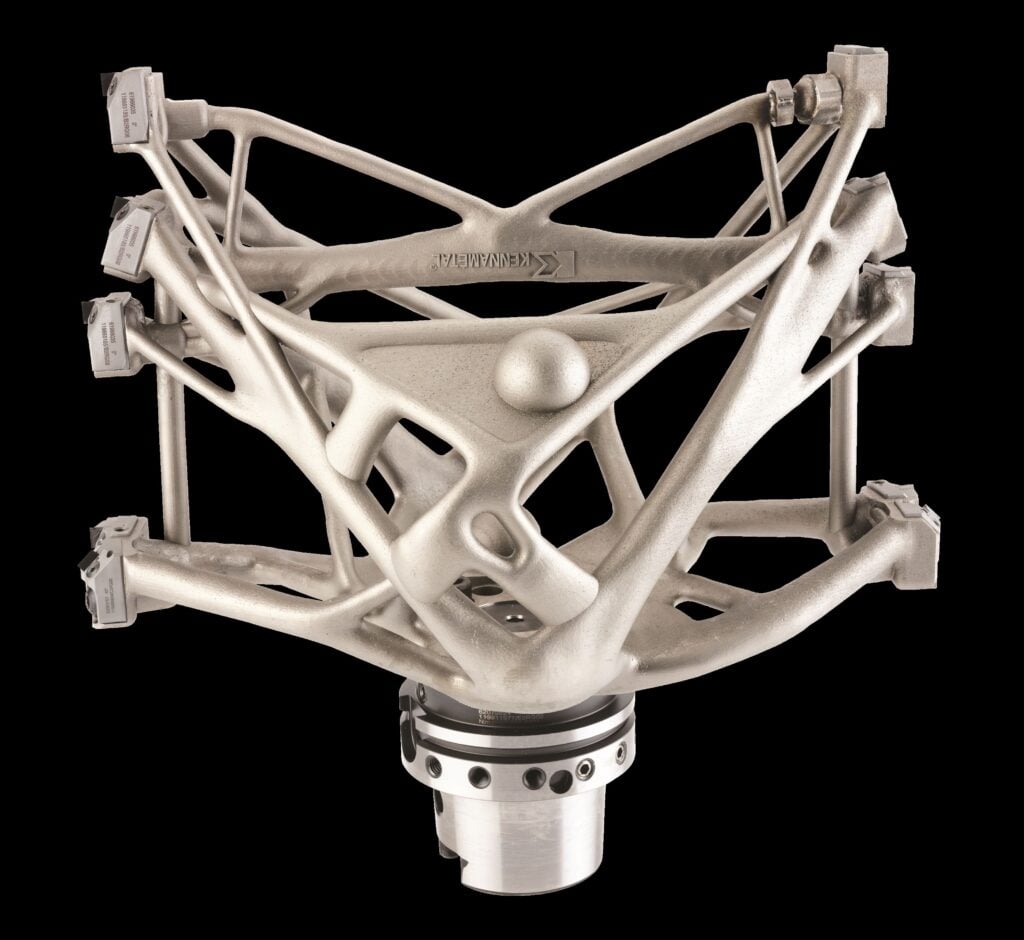
The Results: 50% reduction in machining time
Working in close collaboration with Voith, Kennametal manufactured a prototype tool and put it to the test in its demonstration centre in Fürth, Germany—part of a global network of test and demonstration centres where the company works with customers to design, iterate and validate machining solutions.
This solution was particularly challenging in achieving both manufacturing and part quality requirements. Design simulation, additive manufacturing, and practical tests in the demonstration centre allowed the team to validate the machining results. Voith then conducted the first tests on-site, followed by longer-term tests for series production. Further customer requirements were implemented, and the tool was jointly perfected and finalised.
“The Kennametal tool delivered outstanding quality and performance from the first use, achieving a 50% reduction in machining time while still meeting accuracy and surface finish requirements. Additionally, the reduced weight limits the load on the magazine, tool changer and spindle—effectively reducing maintenance costs,” said Oberländer. “Our collaboration with Kennametal clearly shows the enormous innovation potential of additive manufacturing when applied in such a cooperative partnership.”
Kennametal Additive Manufacturing (AM) offers a game-changing solution by utilising high-performance materials and parts that are produced faster and with the design flexibility of 3D printing.
Kennametal brings nearly a century of materials and manufacturing expertise to every layer of the AM process—from raw material to finished part. This helps customers unlock the full value of 3D printing for applications demanding wear, erosion, corrosion, and high-temperature performance.