08:24
🎧Engineered in record time
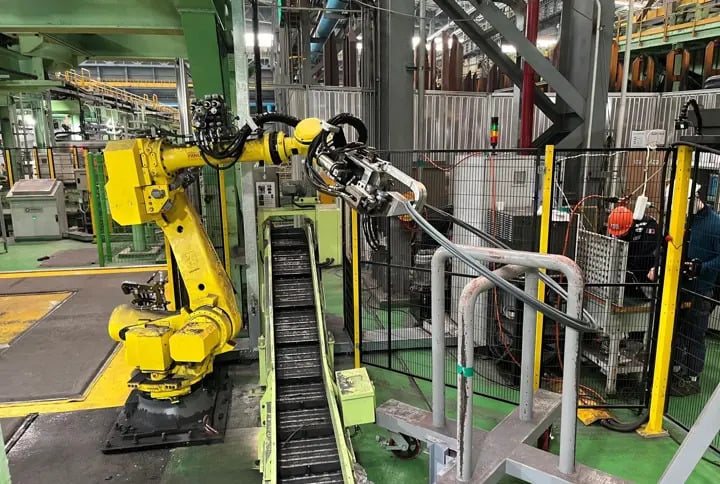
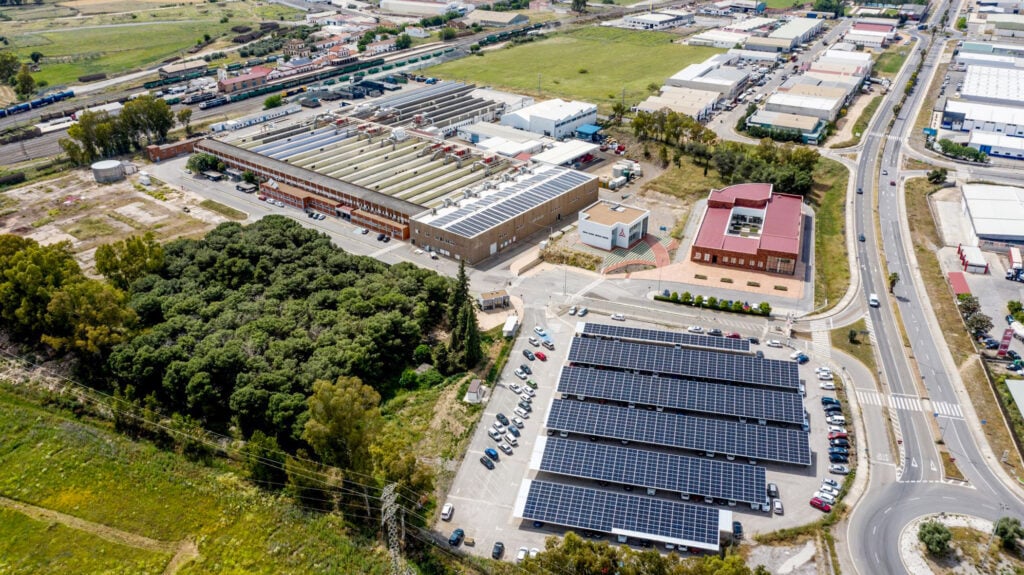
Engines were already being built at the site in Zafra in 1875, where DEUTZ today has its main factory for processing engine components. Around 500 employees in modern manufacturing facilities produce engine blocks, cylinder blocks, connecting rods, and gears for the Group’s assembly lines in Cologne and Ulm.
DEUTZ’s new 3.9-litre diesel engine is mostly used in agriculture but also in the construction equipment segment. As an industrial engine, it is designed for long service life and is to be built until at least 2035. Series production starts in 2025.
This engine, which will be available in a power range from 75 to 130 kW, represents an important future project for DEUTZ. As it is the same size as its 3.6-litre predecessor, it can be installed in the same vehicles where it will provide very efficient performance.
“Our engines are typically deployed in off-highway applications like agricultural and construction machines, which are in constant use and move heavy loads. We’ll continue to need an internal combustion engine to move those machines. For now, it will be in the form we use today: the diesel engine. Synthetic fuels or hydrogen can considerably prolong their deployment,” explains Alejandro Castilla De La Hoya, Zafra Plant Manager.
He points out that the income from this area finances DEUTZ’s investments in the green segment, which is dedicated to the transformation of mobility. The 3.9-litre diesel engine is already set to run on gas or hydrogen in the future. “Based on today’s design, this diesel engine can become a green engine in the long run,” says Manuel Rodríguez López, Industrialisation Manager. This is possible thanks to small modifications, particularly to the cylinder head. However, the engine remains mostly the same. MAPAL is already collaborating on DEUTZ’s first hydrogen engine – a huge 7.8 litres.
Two weeks from design freeze to offer
“Our clients’ development periods for new parts are becoming shorter and shorter,” explains Thomas Spang, Global Head of Tool Management at MAPAL. This represents a growing challenge for tool manufacturers or complete suppliers like MAPAL. This is true if plans change at the last minute while the deadline for the tool design remains the same. For the engine block of the new 3.9-litre diesel engine, MAPAL only had two weeks after the design freeze to complete a final offer.
An ardent team of experts in Aalen completed this ambitious task on time. Well-tuned workflows and many years of experience with the client’s production methods proved advantageous for the team. MAPAL has been conducting tool management for DEUTZ in Spain for 18 years and several projects have been completed together over the years.
MAPAL already engineered the machining of the engine blocks for the predecessor 3.6-litre diesel engine, which meant they could draw on practical experience and didn’t have to start from scratch. For example, the tool experts already knew which machines the engine manufacturer had from previous projects. DEUTZ has equipped its assembly line in Zafra with new 5-axis machines over recent years so that they can easily switch to new products.
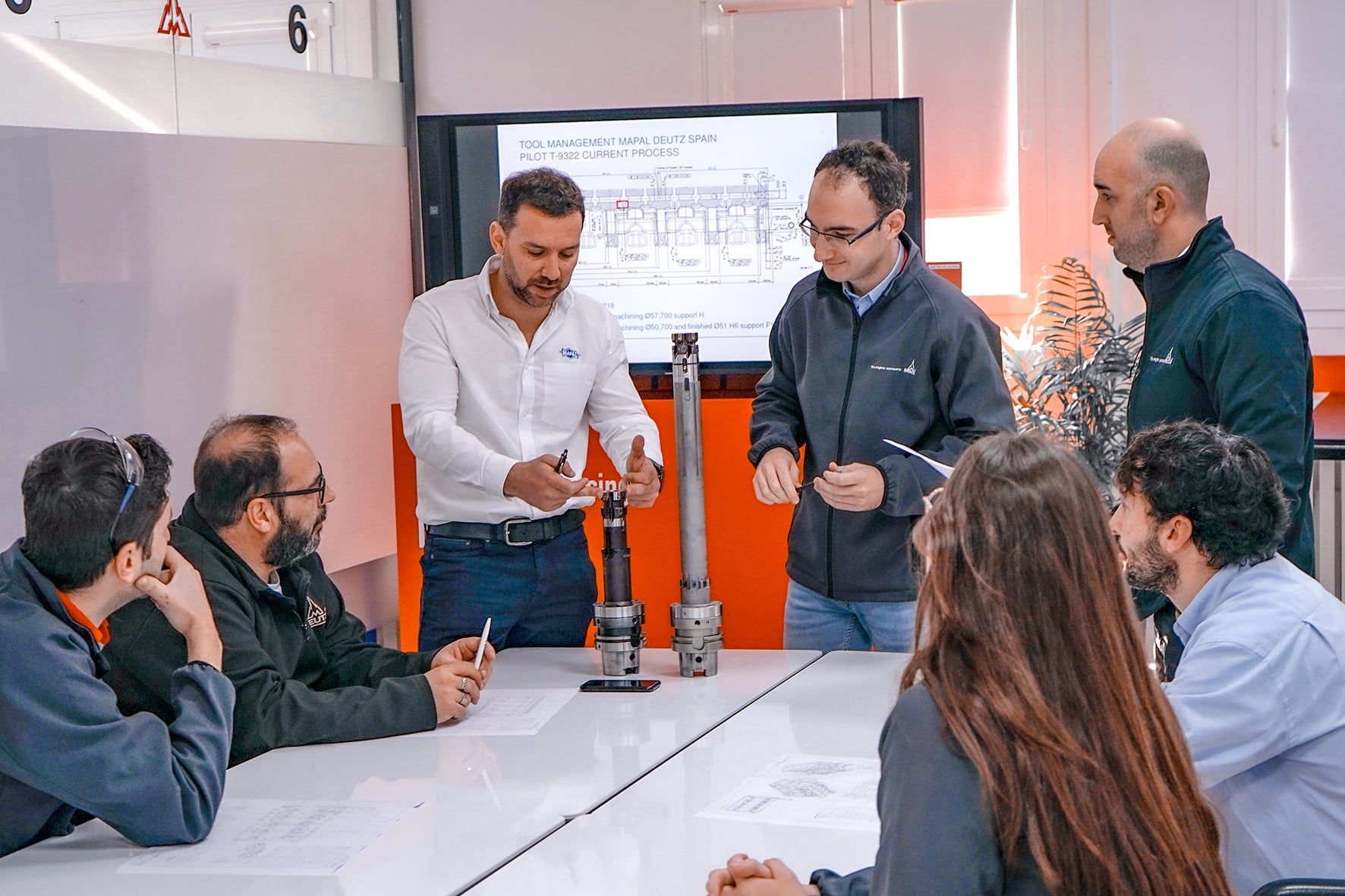
When DEUTZ sent their request, the Tool Management department, in collaboration with the Technology Expert Team (TET) in Aalen, first gave some thought to the production process. “To be quick here, we don’t concern ourselves with detail at this early stage, but instead pull together reference tools and concepts from previously completed projects,” explains Harald Traub from TET. As a project engineer, he is responsible for planning the entire process. “In this way, we can specify an approximate budget and the rough scope of the tool package for the client.”
One hundred different tools for an engine block
After this rough planning, the concrete tool design followed in the second week. In the end, MAPAL’s offer for the series production of the motor block included almost 100 different tools. Many custom tools achieve short machining times and, thus, high economic efficiency. Aside from these, standard tools are used mainly for milling.
A few close-to-standard tools were also used to produce prototypes quickly. Series production can then begin with the optimal set of tools. As part of their original delivery, MAPAL supplied consumable tools as well as the required tool holders and adapters to DEUTZ. All other consumables will be handled by the tool management on-site. From now on, the client no longer pays per tool but per completed part—i.e., the cost per part is billed.
The unit costs at first correspond to the price determined during engineering. Certain ratios have been agreed upon for the following years. The client receives an increasing rebate percentage and pays a bit less per unit every year. For this business model to work out, MAPAL has to implement continual improvements to save costs. This is done with new tool technologies and corresponding optimisation. The costs per part are fixed over the contract term, after which a reassessment occurs. Such contracts run over four to five years and offer the client planning security.
“With our engineering expertise, we support DEUTZ beyond the tool-setting area and cultivate a close partnership,” Spang highlights. After helping to build the prototype, it is the tool management’s turn to shine on-site during series production. DEUTZ uses approximately 1,300 different tools in total. Thousands of tools are available from stock and must be managed in Zafra. To keep inventory optimal, MAPAL uses its warehouse management systems and digital solutions with the cloud-based software c-Com for tool management. The Digital Tool Management 4.0 doesn’t only handle procurement processes, which are initiated semi-automatically; it also acts as a reporting tool to analyse cost drivers and stocks.
Industrialisation Manager Manuel Rodríguez López praises the good collaboration with MAPAL regarding tool management: “Over the course of our cooperation, we have developed extensive technological concepts, which go far beyond mere logistics. Besides achieving cost reductions, tool setting is particularly important for us. The MAPAL employees working on-site have much know-how and ensure that production has exactly the tool they need at the right time.”
MAPAL’s tool manager on site is David Castaño. MAPAL also employs tool setters permanently in Zafra. They make sure that a dozen different parts are produced without a hitch. “It is very beneficial to have David here on-site with us,” emphasises Manuel Padilla Fernández, Manufacturing Engineering Manager at DEUTZ. “We can talk about any opportunities for optimisation directly at the machine. We don’t consider David Castaño an external service provider but a part of our team. It’s a very strong cooperation.”
Developing together to solve problems
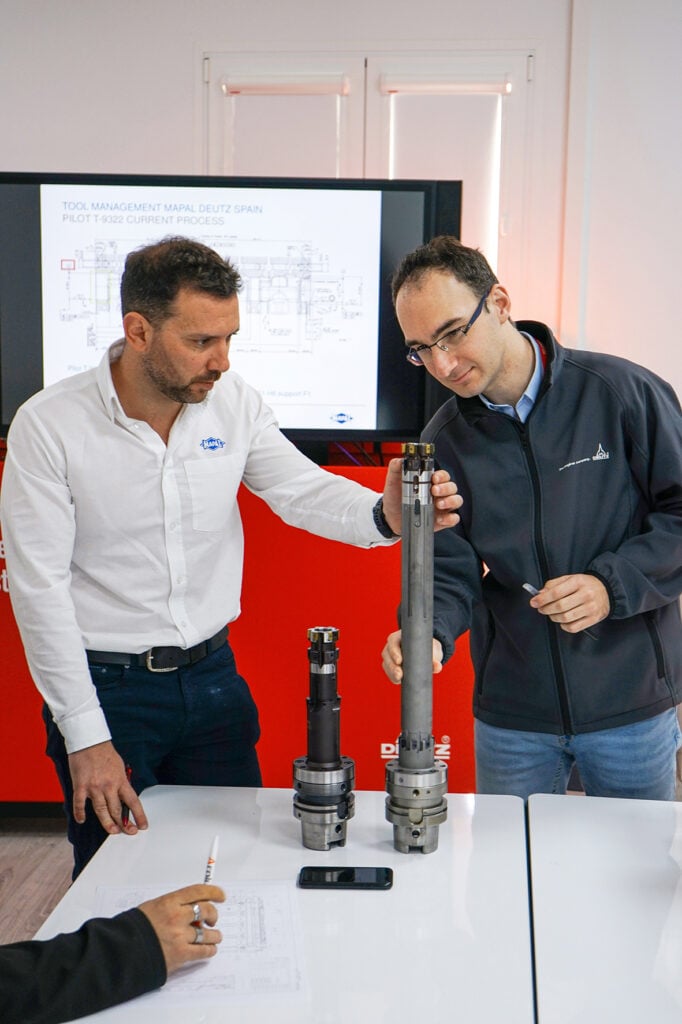
If required, new tool solutions can be developed in Aalen via the local MAPAL team. That was the case in Zafra when it became necessary to optimise the tools for machining the bore in the crankshaft and camshaft. A new machining concept from MAPAL with the HPR400 reamer was implemented in cooperation with DEUTZ. David Castaño is convinced of its advantages: “The tool life of the previous tool was 350 units, and resetting was required every 100 units. With the HPR400, we achieve a tool life of 1,000 parts without resetting. The resulting machining quality is exceptionally good.”