
imagine the amount of thread contained in this mountain of clothing? No ? We either, but they are probably millions of kilometers. All this thread was wrapped and unrolled many times during treatment. And this is just one of the steps in the textile industry processes in which FAULHABER’s compact and durable drives prove themselves day after day.
Tradition of machines
The industrial revolution did not start with the steam engine as many people think. This was used to evacuate water from coal mines. It was only with the use of thermal power for the mechanical loom that the first mechanical production process was created, marking the beginning of modern mass production. Textile machines have a tradition that goes back more than two centuries. Over time, they have become extremely complex and often very large. Today, they make the fabric for the seemingly endless choice of clothes that we find online and in chain stores. The size of the machines contrasts strikingly with the delicate material they handle: light fibers like feathers that are first spun into threads sometimes as fine as a hair. The result is textiles – from Latin textilis = weaving – per square kilometer. Countless rolls of yarn are consumed during the process.
Semi-finished product in rolls
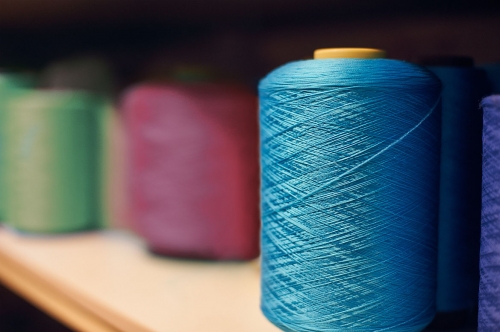
The rollers must of course be rolled up first. This is done in a spinning where the yarn is created from the raw fibers. This is where the semi-finished product is wrapped on large coils. The wire is usually rewound on smaller coils. As soon as the yarn is produced, the individual fibers are often intertwined to form a twisted yarn in order to increase its volume and improve its stability. The yarn is unrolled and rewound at almost every stage of the process before final processing. It also helps to increase the quality of the intermediate results. Anyone who has already sewn a button or repaired a seam knows the regular tiles that the thread forms on the reel. In the textile industry, it’s the same, but bigger, even if other models of winding are also possible. The surface, most often diamond shaped, is formed because the wire is wound on the coil in a very specific pattern, generally oblique. It usually goes from one end to the other, then does the same in the opposite direction. This guarantees a uniform distribution of the wire and allows to unroll it then without problem.
Fast oscillation
The mechanical winding is extremely fast. During this process, the wire must be moved in a way that is both constant and very fast between the two ends of the coil. There must be no delay when changing direction. This is a real technical feat because the eyelet guide wire comes and go about 400 times per minute, treating nearly 1500 meters of wire. There are also passive mechanical guides, but the motorized wire guide is much superior to them. It is the standard in modern wire winding machines. The motor charged with fast oscillation must above all be able to handle rapid changes of direction without delay and while keeping the same speed, it works without problems as long as possible. Disc magnet motors, such as the DM52, have proven to be an ideal solution for this task. The rotor of this drive consists of a rare earth magnet disk magnetized with 25 pairs of poles. This disc moves between two stators with the windings arranged accordingly. Thanks to its extreme lightness, the inert rotor is very close to the achievable minimum. This allows the engine to change direction in about five milliseconds at full speed, thus allowing for a super-fast back-and-forth motion while guiding the wire. Thanks to its extreme lightness, the inert rotor is very close to the achievable minimum. This allows the engine to change direction in about five milliseconds at full speed, thus allowing for a super-fast back-and-forth motion while guiding the wire. Thanks to its extreme lightness, the inert rotor is very close to the achievable minimum. This allows the engine to change direction in about five milliseconds at full speed, thus allowing for a super-fast back-and-forth motion while guiding the wire.
Photo: Textile application
Motorized finger
For feeding the yarn, a so-called loader is also used, through which the yarn passes before entering a knitting machine. This charger does not guarantee the uniformity of the winding, but rather the constancy of the tension of the wire. In the mechanical knitter, he plays the role of the little left finger when knitting by hand. It is fixed at a short distance in front of the knitting systems of the knitting machine. A small amount of wire is wrapped around its roll which serves as a buffer. Its mechanics react to the variations of the tension of the wire and compensates them by various motorized movements. Here, the movements do not need to be as fast as for the winding of thread. What is important is the prompt reaction of the drive and fine metering of engine power. However, the available space is also very limited and the engines must of course not determine the maintenance cycles. As with all machines, longevity is also a top priority here. Depending on the user, different FAULHABER motors are used for this task, such as graphite switching DC motors.
Knitting technology
Moreover, modern knitting machines do not just knit socks and sweaters, they are also used to produce technical fabrics. The new 3D knitting technology even makes it possible to create three-dimensional structures. It is used in particular for the manufacture of technical components from fine metal son or ceramic fibers. The correct tension of the yarn is then essential because it is a determining factor for the dimensions and the quality of the products. This manufacturing technology can also be used for rapid prototyping. It uses the material very economically, with just as much thread as it really needs. Unlike most other prototyping methods, there are no cuts or other material residues. Among the various processes of the textile industry, high quality micromotors are also used in many other applications. For example, they are used in button sewing machines as well as in material testing devices to examine the quality of threads. The extensive product range of FAULHABER offers an optimal drive solution for all these applications.
Box: Training experts
FAULHABER specializes in the development, production and operation of high precision miniature drive systems, servo components and controls with a power output of up to 200 watts. The company also produces complete customer solutions and offers a wide range of standard products, such as brushless motors, DC micromotors, encoders and motion controllers. The FAULHABER brand is synonymous worldwide with quality and reliability in complex and demanding application areas such as medical technology, industrial automation, precision optics, telecommunications, aeronautics and aerospace. as well as robotics. DC motor high performance with a continuous torque of 200 mNm with a filamentary micro-drive with an outside diameter of 1.9 mm, the FAULHABER standard range includes more than 25 million possibilities to assemble an optimal drive system for an application. This technological module is also the basis for modifications to meet the special wishes of customers concerning special models