08:24
🎧 – Mill-turn centres machine to high accuracy and surface finish
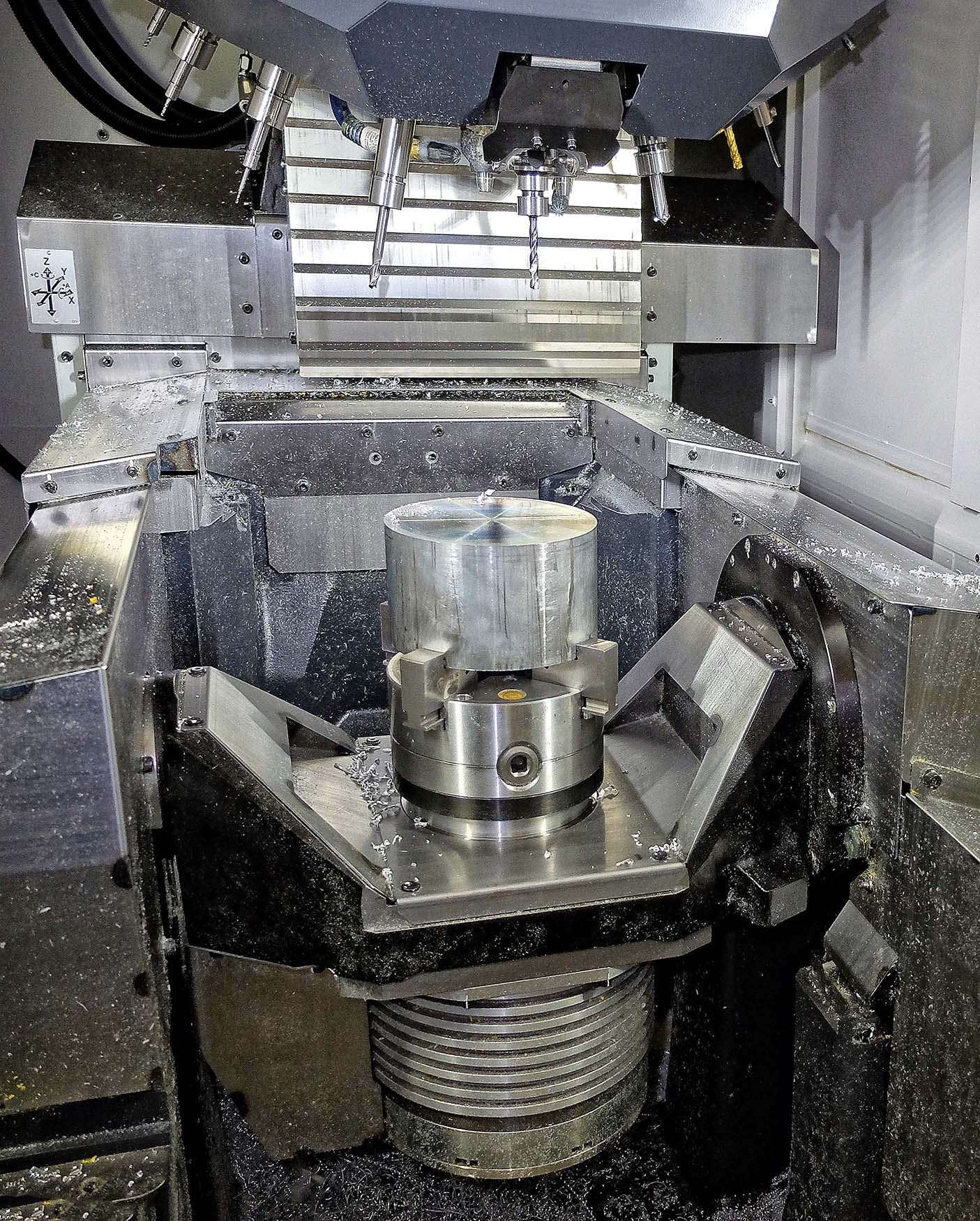
Two Japanese-built Brother Speedio M140X2 5-axis mill-turn centres with a 22-position magazine for 30-taper tools have been supplied by UK agent Whitehouse Machine Tools to Jointmedica, which carries out world-leading R&D into optimal design and manufacture of artificial knees and hips.
For the creation of new prosthesis designs for hip and knee replacements, a new manufacturing cell has been established at the company’s Centre for Manufacturing Research in Hallow, near Worcester. It opened seven years ago under the present management, although Jointmedica was established back in 2008.
Managing Director Terry Smith said: “The essence of successful implant performance is supreme quality, not only of the materials used but also of the design, manufacture and insertion of the prosthetic during orthopaedic surgery.
“A case in point is one of our projects, the Polymotion Hip Resurfacing concept. It comprises a highly polished femoral head currently produced by a partner company using a special low-nickel cobalt-chrome alloy attached to the top of the femur, which locates into a plastic acetabular cup inserted into the pelvis.”
Technical Director Roger Ashton added: “Metal-on-metal hip resurfacing and hip replacement technology has all but disappeared globally due to several products on the market performing below expectations, and in some cases causing significant problems in patients.”
“Some designs with which I have been involved continue to perform extremely well, going on to deliver class-leading results in thousands of satisfied patients. This previous product familiarity provides the basis for our ongoing development of hip resurfacing.”
He went on to explain that currently, the remaining hip resurfacing solutions are metal-on-metal, with several companies exploring the use of ceramic-on-ceramic articulations in an attempt to retain the advantages of the procedure. Jointmedica is privileged to be working with Derek McMinn and Ronan Treacy, both pioneers of hip resurfacing implant design and global authorities on metal-on-metal hip resurfacing gleaned from over 20 years of experience with their previous hip resurfacing enterprise, the Birmingham Hip Resurfacing of Smith & Nephew Orthopaedics.
Together with these specialists, Jointmedica is conducting research into the optimal medical-grade polymer to replace the cobalt chrome previously used for the cup. It believes this approach to hip resurfacing offers significant advantages to surgeons and more importantly, the patients who may receive these implants at a relatively young age.

The company identified a type of highly cross-linked polyethylene with a porous coating as offering the ideal characteristics for use in hip resurfacing. Prototypes are undergoing exhaustive tests in the R&D cell. At its core are the two Brother mill-turn centres, equipped with Blum in-process gauging and tool probing, on which simple turned forms and complex free-form implant shapes can be readily attained.
Development products can be secured easily in an expanding collet on the torque table of the Brother M140X2s. Turning and milling operations are then combined to achieve the appropriate geometry, surface texture and finish. Every completed implant is inspected on an Aberlink ‘Axiom too’ shop-floor coordinate measuring machine to affirm geometrical characteristics and ensure dimensional accuracy.
Function and wear simulators are used alongside the in-house development work to prove the safety and efficacy of the resulting implants. In the case of hip resurfacing and hip replacement designs, these simulators load and articulate the bearing through millions of cycles in a manner that mimics human movement.
To support the venture financially, in October 2017 Jointmedica was awarded a Proof of Concept grant from Worcestershire County Council as part of the European Regional Development Fund. Five months later, the company received further significant funding assistance from innovation agency, Innovate UK, whose remit is to find and drive science and technology that will expand the UK economy.
Mr Ashton continued: “When we reviewed the options for the machining element of our manufacturing cell, which involves the complex milling of textured surfaces and single-point turning of bearing surfaces, we originally thought we would need a 5-axis machining centre and a CNC lathe.”
“The availability of the Brother M140X2 mill with accurate turning capability using a direct-drive, 2,000rpm torque table offered us the chance to complete all cutting operations on a single platform.”

It was felt that the 30-taper tool interface would suffice for machining all materials to be used in these orthopaedic devices and such machines have the additional advantage of a small footprint. Mr Ashton’s preference was for a true 5-axis machine rather than a 3-axis model with a compound CNC table, as the former would ensure the necessary functionality within a compact envelope.
Three options on the market were considered. The Brother machine was selected due to its superior turning capacity as well as its fast axis movements. These are carried out in four of the five CNC axes simultaneously during non-cutting times together with the 0.9 second tool change, so idle times are minimal. Cutting feed rate is high at up to 30m/min, maximising stock removal for high productivity.
Manufacturing Engineer Oliver Clayton commented: “The capabilities of these milling machines are beyond impressive. During my induction training, I was able to produce sample parts in record time. The cutting performance and level of detail I can achieve with this variant of the Brother line-up exceeds our expectations.”
Other facets of the installations he singles out for praise are the machines’ speed, accuracy and user-friendliness, especially regarding the usability of the Brother high-speed control system, which he describes as being convenient for editing the off-line programmed feeds and speeds and as having a huge memory able to hold multiple program files.